
LCL Shipping from China for Small Businesses
 Written by Olivia ZhangPublished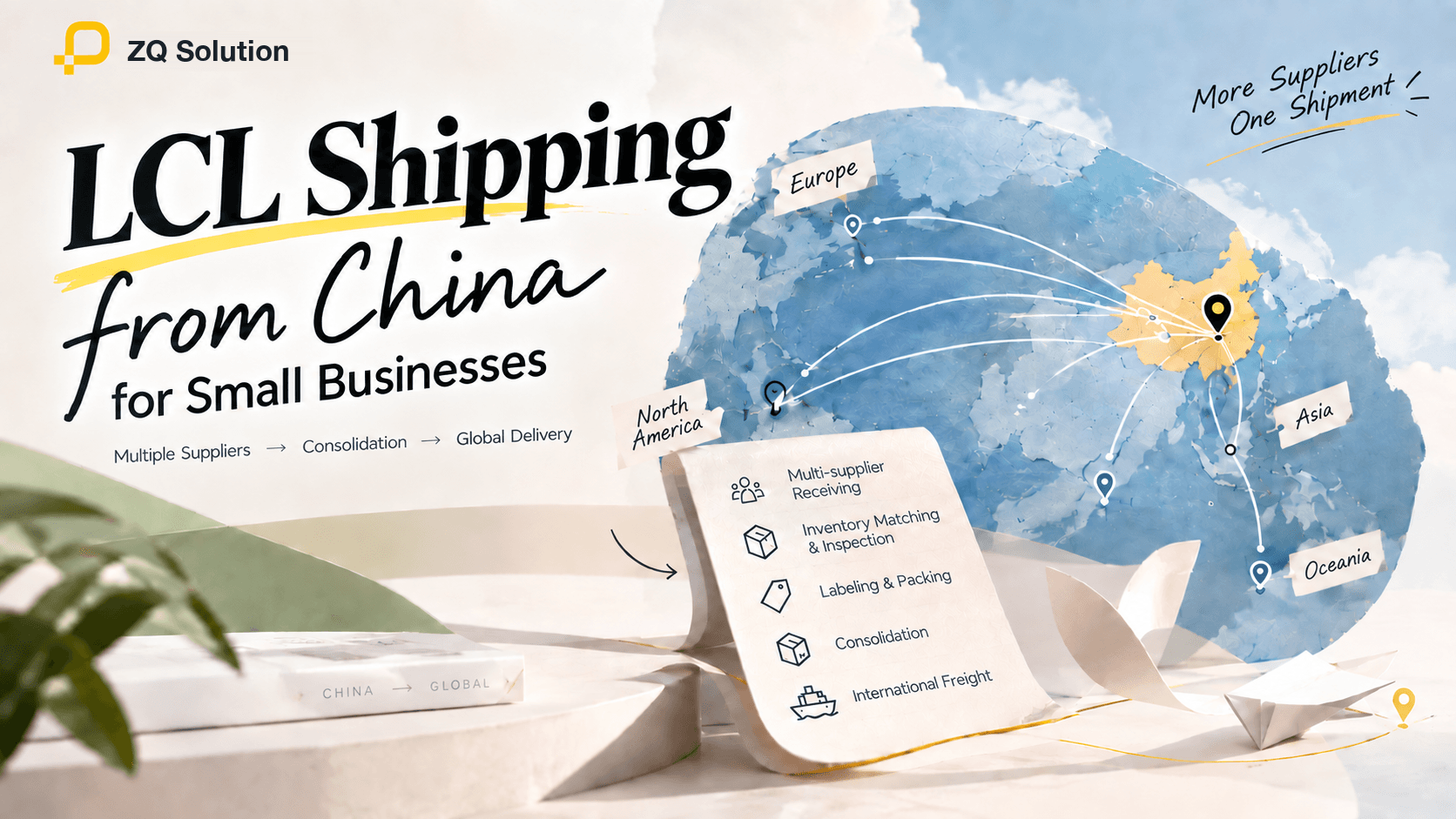
When LCL Shipping from China Makes Sense
If your inventory comes from several Chinese suppliers and needs to go to Amazon FBA, a third-party logistics provider (3PL), your own warehouse, or another business address, LCL shipping allows you to consolidate less-than-container-load inventory in China before sending it as one shipment.
You can continue working with your existing suppliers. Once the goods arrive at ZQ's receiving facility in China, ZQ can match the incoming goods, inspect them, apply labels, prepare the packaging, record the final carton data, and consolidate the inventory within the agreed service scope. The shipping plan is then matched to the actual carton data, destination, cargo attributes, and delivery requirements.
Table of Contents
- When LCL Shipping from China Makes Sense
- How ZQ Prepares Multi-Supplier Cargo for LCL Shipping
- How LCL Shipping Costs Are Calculated
- Recalculate Shipping Costs Without Waiting for a Manual Quote
- LCL Shipping Cost Examples: United States and Germany
- Shipping Consolidated Cargo to Amazon FBA, 3PLs, and Commercial Warehouses
- What Information You Need to Start
- Plan Your LCL Shipment from China with ZQ
- Frequently Asked Questions
How ZQ Prepares Multi-Supplier Cargo for LCL Shipping
| Service | What ZQ Handles | What You Need to Provide |
|---|---|---|
| Multi-supplier receiving | Receive goods from one or more Chinese suppliers and identify each incoming shipment using the supplier details, domestic tracking number, and product/SKU information | Supplier details, domestic tracking numbers, product/SKU information, and declaration details such as HS codes |
| Inventory and SKU verification | Match the goods received against the corresponding products, variants, quantities, and inventory records | Product names, SKUs, variants, and quantities |
| Inspection to the agreed scope | Inspect the products or packaging against the agreed criteria and report visible issues | Inspection scope, inspection priorities, and product requirements |
| Labeling | Apply seller-uploaded SKU labels, FNSKUs, carton marks, warehouse labels, or other specified labels. If no SKU label is uploaded, the ZQ system can generate a default 100 × 50 mm CODE-128 label from the Variant ID. 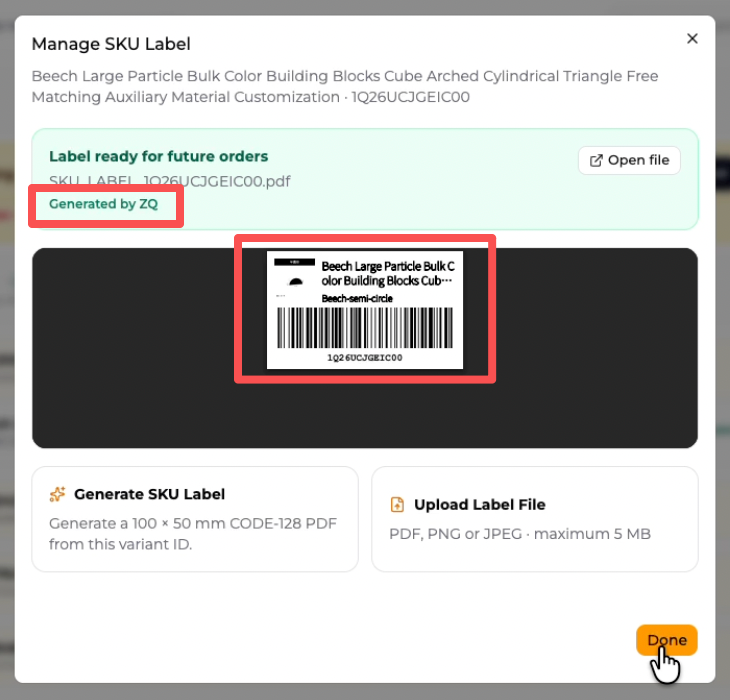 |
Custom label files, if any; labeling instructions; destination-warehouse requirements; and any required FNSKUs, carton marks, or destination-specific labels |
| Packing and shipment preparation | Replace cartons, repack, reinforce, waterproof, add impact protection or corner guards, palletize, or prepare wooden crates as confirmed | Packing requirements, vulnerable areas, special requirements such as palletizing or wooden crating, and destination-warehouse rules |
| Final carton confirmation | After final packing, ZQ Warehouse sends the system the SKUs and quantities in each carton, the carton count, weight, and outer dimensions | Special packing instructions and destination-warehouse rules, if any |
| Multi-SKU consolidation | Combine confirmed inventory that shares the same destination, receiving requirements, and shipping plan | Destination and shipping deadline |
| International shipping coordination | Match the final cargo data, destination, and cargo attributes to available sea, land, or air routes | Country, postal code, delivery type, cargo attributes, and destination-warehouse details |
In practical terms, ZQ handles more than a single booking. It manages the preparation work between supplier delivery in China and the point when the cargo is ready for international shipment. This keeps supplier arrivals, warehouse operations, final carton data, and the international shipping plan within one coordinated workflow instead of splitting them across several service providers.
How LCL Shipping Costs Are Calculated
ZQ displays bulk-shipping prices in the Shipping Cost Calculator and in the shipping calculator inside the ZQ system.
Bulk Ship pricing cannot be reduced to volume alone or to one fixed calculation. Billing rules can vary by route. The system will generally calculate dimensional weight from the outer carton dimensions and compare it with actual weight, but the billable weight and price shown for the selected route are the figures that apply. Before the goods arrive at ZQ, you can use supplier-provided or currently available packing data to create an initial estimate. Enter each carton type separately:
- Outer-carton length, width, and height
- Gross weight per carton
- Number of cartons with the same specifications
- Destination country, postal code, and delivery type
- Cargo attributes, such as general cargo, battery-powered goods, liquids, textiles, or branded goods
The system uses the carton data to calculate total volume and dimensional weight, then returns eligible routes, estimated shipping costs, billable weight, and the transit time displayed for each route.
Declared volume (CBM) is optional and can normally be left blank. Enter it only when a specific shipping product explicitly requires pricing based on a separately declared cubic-metre volume.
Weight, dimensions, and packing data supplied before arrival are often not accurate enough for final pricing and should be used only for budgeting.
After the goods reach ZQ, they must first be identified, checked against the expected products and quantities, checked into inventory, and processed under the agreed warehouse-service scope. Once ZQ Warehouse completes final packing, the system records the measured final volume, carton count, and actual weight. ZQ uses those final figures together with the final delivery address to confirm the applicable route and final price. You can also enter the same final figures into the Shipping Cost Calculator to view the corresponding routes and prices.
The shipping method and cargo attributes also affect order setup and pricing. Land and sea shipments follow the rules of the specific route. For air freight, general cargo and sensitive goods such as battery-powered products should be placed in separate Bulk Ship Orders, and the available routes and prices may differ.
Warehousing, Labeling, and Value-Added Service Fees
The system displays a standard shipping estimate based on the current route and cargo data. Chinese warehouse services outside the standard shipping scope—such as additional labeling, repacking, custom packaging, palletizing, wooden crating, product inspection, furniture assembly, damage repair, or special reinforcement—are confirmed and charged separately.
Labeling can include SKU labels, FNSKUs, carton marks, warehouse labels, or destination-specific labels. You may upload your own label files. If you select labeling but do not upload an SKU label, the ZQ system can generate a default 100 × 50 mm CODE-128 SKU label from the Variant ID. FNSKUs, carton marks, and destination-specific labels must still be provided or confirmed according to the relevant platform or warehouse requirements. The applicable warehousing and value-added service fees are shown in the relevant ZQ workflow or confirmed before the service is performed. You pay only for the services you approve and use; unused add-on services are not included in the standard shipping estimate.
Recalculate Shipping Costs Without Waiting for a Manual Quote
If the product, SKU mix, packing plan, or destination warehouse changes, you can update the available data and run another estimate instead of waiting for a manual quote every time you compare options. After the goods reach ZQ and complete receiving checks, inventory check-in, the agreed warehouse operations, and final packing, the final shipping price is confirmed using the warehouse-recorded carton data, actual weight, final delivery address, and available route.
Use the ZQ website's Shipping Cost Calculator or the calculator inside the ZQ system to update the cargo data and view the corresponding available routes and shipping estimates.
For example, you can:
- Enter new outer-carton dimensions after changing the packing plan;
- Change the destination postal code to compare delivery regions;
- Increase or reduce the carton count to estimate the effect of a volume change;
- Update the cargo attributes after changing the product or SKU mix; or
- Compare estimated shipping costs for different countries, commercial warehouses, or third-party warehouses.
The system matches routes to the data entered at that time. This allows operations and supply-chain teams to assess costs while planning replenishment, inventory, and destination-warehouse arrangements instead of waiting for a manual recalculation after every change.
LCL Shipping Cost Examples: United States and Germany
The following sea-shipping estimates were returned after the same cargo details were entered into the ZQ Shipping Cost Calculator. The example compares budgets across destinations and routes. The prices shown are system estimates based on the data entered at that time and do not replace final pricing after the goods have been packed.
Example cargo:
- 12 cartons
- Carton dimensions: 60 × 40 × 40 cm each
- Gross weight: 12 kg per carton
- Total actual weight: 144 kg
- Total volume calculated automatically from the carton data: 1.152 m³
Declared volumeleft blank- Billable weight displayed by the system: 192 kg
- Cargo attribute: General cargo
| Destination | Matched Route | Estimated Cost | Transit Time Displayed | Billable Weight |
|---|---|---|---|---|
| United States (ZIP Code 90021) | US Parcel — Standard Sea | USD 418.06 | 22–28 days to pickup | 192 kg |
| United States (ZIP Code 90021) | US Parcel — 22-Day | USD 450.59 | 20–22 days to pickup | 192 kg |
| United States (ZIP Code 90021) | US Parcel — HEDE 18-Day | USD 487.74 | 16–18 days to pickup | 192 kg |
| United States (ZIP Code 90021) | US Sea (Economy) - Los Angeles | USD 506.33 | 22–30 days total transit (door to door) | 192 kg |
| United States (ZIP Code 90021) | US Sea (Standard Express) | USD 557.42 | 17–24 days total transit (door to door) | 192 kg |
| United States (ZIP Code 90021) | US Sea (OA Slow Boat) | USD 613.16 | 20 calendar days to pickup | 192 kg |
| United States (ZIP Code 90021) | US Parcel — Matson 18-Day | USD 627.09 | 16–18 days to pickup | 192 kg |
| Germany (Postal Code 60311) | Europe Sea Courier — Deferred | USD 371.61 | 40–45 days after departure | 192 kg |
| Germany (Postal Code 60311) | Europe Sea Courier (Express) — Deferred | USD 394.85 | 30–35 days after departure | 192 kg |
| Germany (Postal Code 60311) | EU Parcel — Sea | USD 426.89 | ~50 days to pickup | 192 kg |
| Germany (Postal Code 60311) | EU Parcel — Rail | USD 533.73 | See carrier for timeline | 192 kg |
| Germany (Postal Code 60311) | EU Sea (Oversized) | USD 998.42 | See carrier for timeline | 192 kg |
| Germany (Postal Code 60311) | EU Rail (Oversized) | USD 1,133.13 | See carrier for timeline | 192 kg |
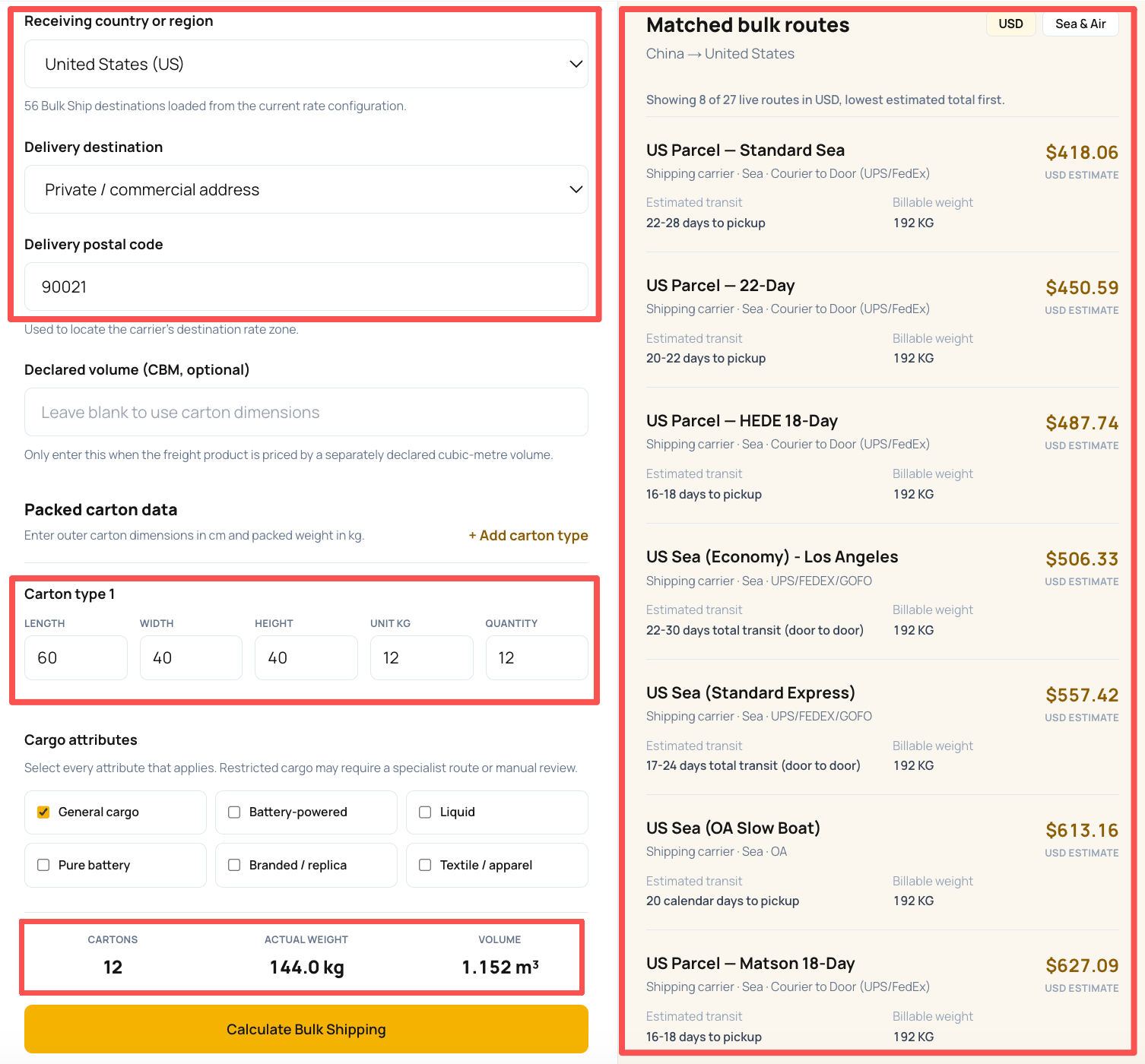
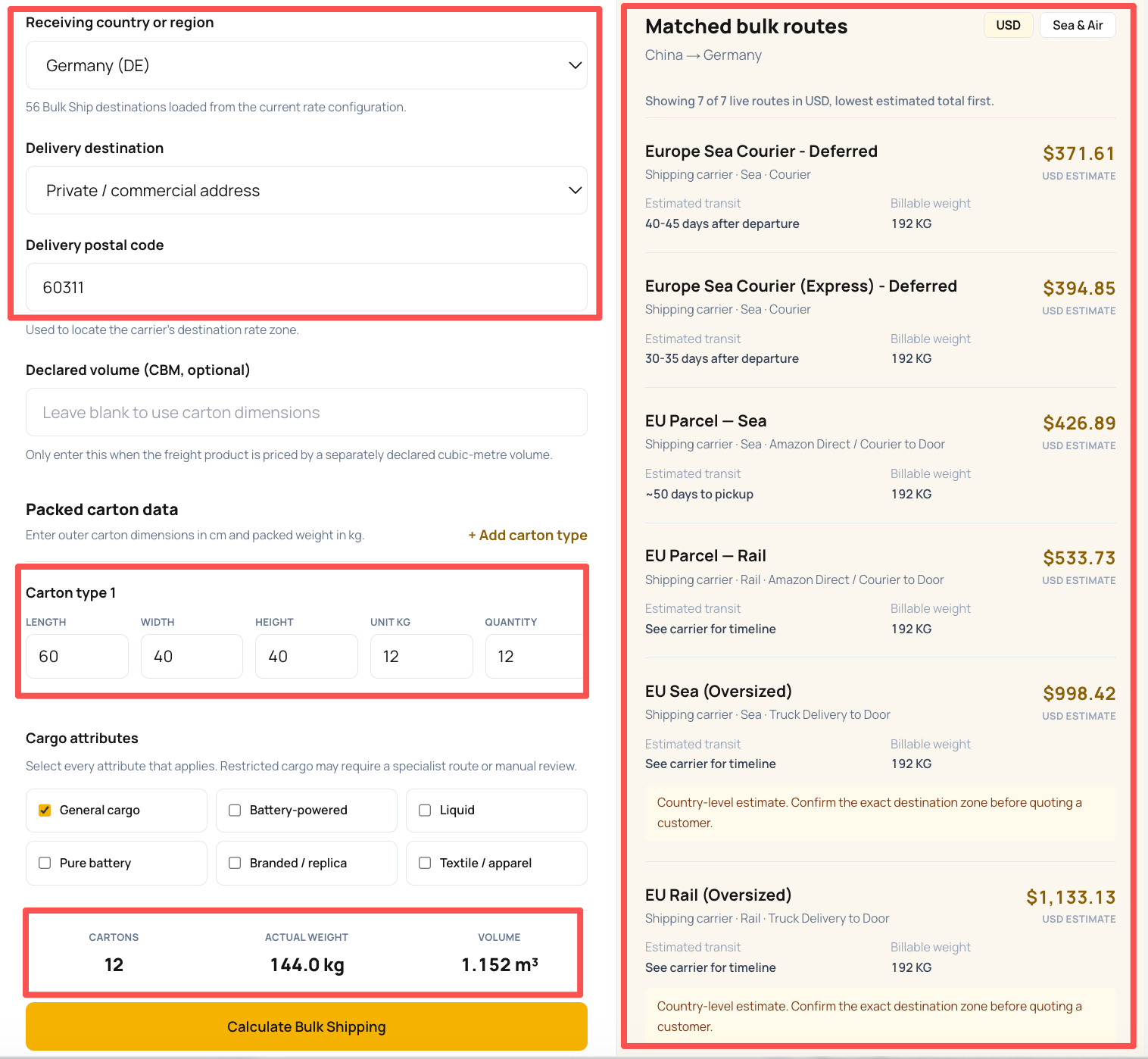
These prices are route and budget examples based on the carton data, destination, and cargo attributes shown in the screenshots. Once the goods arrive, complete receiving and inventory check-in, and are packed in their final cartons, the final price is confirmed using the outer-carton dimensions, actual weight, final delivery address, route conditions, and service scope recorded by ZQ Warehouse.
Transit-time starting points are not consistent across routes. A route may show days to pickup, days after departure, total transit (door to door), or ask you to confirm the timeline with the carrier. Before comparing the number of days, check the event from which each route starts counting. A smaller number does not automatically mean a faster end-to-end service.
Shipping Consolidated Cargo to Amazon FBA, 3PLs, and Commercial Warehouses
Receiving rules vary by destination warehouse. You provide the information and documents required by the destination, and ZQ handles the China-side preparation and shipping coordination within the confirmed service scope.
| Final Destination | What You Need to Provide | What ZQ Can Handle |
|---|---|---|
| Amazon FBA | Amazon inbound plan, FNSKUs, carton labels, pallet or outer-carton requirements, and final receiving-warehouse details | Apply the labels you provide, prepare the goods to the confirmed requirements, record the final carton data, and coordinate the shipment handoff |
| 3PL | Receiving address, SKU/carton-mark requirements, ASN, appointment requirements, and pallet or inbound rules | Multi-supplier receiving, inventory verification, agreed QC, labeling, packing preparation, consolidation, carton-data recording, and shipping coordination |
| Overseas or commercial warehouse | Address, postal code, receiving hours, label requirements, and warehouse operating rules | Prepare the goods to the confirmed standard and arrange a route that meets the destination requirements |
You remain responsible for the items that must be created or confirmed inside your Amazon, 3PL, or destination-warehouse account, such as the inbound plan, account-level labeling rules, and final inventory allocation. ZQ uses the information you confirm to perform the China-side warehouse work and coordinate international shipping.
Documents Generated from the Final Bulk Ship Order
After the final Bulk Ship Order is created, the ZQ system automatically generates a Pro Forma Invoice, Commercial Invoice, and Packing List from the confirmed order data. ZQ uses these documents to coordinate the carrier, export declaration, and destination customs-clearance process for the selected route. The products, quantities, carton data, and destination details in the documents correspond to the final shipping order.
Before shipment, you need to confirm that the product descriptions, quantities, declared values, and importer details are accurate. You must also provide any compliance certificates, brand authorizations, import permits, or other supporting documents required for the product or destination. Duties and taxes, the Importer of Record arrangement, and route-specific customs requirements are confirmed according to the selected route and destination rules. Providing and checking this information is part of the normal customs-clearance process; it does not mean you must arrange the entire export declaration and customs-clearance workflow yourself.
What Information You Need to Start
To help ZQ receive, prepare, and arrange your inventory accurately, provide the core information for this shipment:
- Supplier list, expected ready/dispatch dates, and Chinese domestic tracking numbers
- Product names, SKUs, variants, and quantities
- Final destination, postal code, delivery type, and last-mile requirements, such as forklift unloading
- Any currently available outer-carton dimensions, gross weight, and carton count
- Whether you need inspection, labeling, repacking, reinforcement, palletizing, or another warehouse service
- Cargo attributes, such as battery-powered goods, liquids, textiles, or branded goods
- Commercial documents and importer details required for the destination and shipping method
If the supplier has not provided final carton data, use the available information only for an initial budget before the goods are checked into inventory. After the goods arrive, ZQ first completes receiving checks and inventory check-in, then performs the confirmed labeling, packing, and other warehouse work. Once final packing is complete, ZQ records and sends the final carton data to the system for final pricing and shipping arrangements.
Plan Your LCL Shipment from China with ZQ
For multi-supplier, multi-SKU inventory going to Amazon FBA, a 3PL, an overseas warehouse, or a commercial warehouse, ZQ can connect China-side receiving, cargo preparation, final carton confirmation, consolidation, and international shipping within one workflow.
- View a shipping estimate directly: use the ZQ Shipping Cost Calculator to enter the destination, cargo attributes, and carton data, then view available routes, estimated costs, and billable weight.
- See how the system workflow operates: read How to Ship Products from Multiple Suppliers in China With ZQ for the inbound, inventory, and shipping process.
Frequently Asked Questions
1. Can I Use LCL Shipping Without Filling a Container?
Yes. LCL shipping is suitable when you do not have enough commercial inventory to use a full container. ZQ can receive and prepare inventory from one or more Chinese suppliers, then coordinate sea shipping to Amazon FBA, a 3PL, an overseas warehouse, a commercial warehouse, or another eligible destination.
Available routes depend on the final cartons, destination, cargo attributes, delivery method, and import requirements. Run the search using the final shippable carton data and destination information whenever those details are available.
2. Can ZQ Combine Goods from Multiple Chinese Suppliers into One Shipment?
Yes. You can continue working with your existing 1688 sellers, Taobao suppliers, factories, or independent suppliers. After the goods reach ZQ's receiving facility in China, ZQ identifies each incoming shipment from the supplier details, domestic tracking number, and product/SKU information. ZQ then checks the products, SKUs, and quantities, checks the confirmed goods into inventory, completes the agreed China-side services, and consolidates eligible inventory going to the same destination.
3. Can ZQ Ship Consolidated Inventory to Amazon FBA, a 3PL, or a Commercial Warehouse?
Yes. You provide the final destination-warehouse details and receiving requirements, together with any custom labels, FNSKUs, carton marks, or destination-specific labels that apply. Within the confirmed service scope, ZQ handles receiving in China, inventory verification, agreed QC, labeling, packing preparation, final carton recording, and shipping coordination.
You still need to confirm the destination warehouse's inbound plan, labeling rules, appointment requirements, and account-level inventory allocation.
4. How Are LCL Shipping Costs Calculated?
ZQ displays shipping estimates in the Shipping Cost Calculator and the calculator inside the ZQ system. Billing rules vary by route. The system will generally calculate dimensional weight from the outer-carton dimensions and compare it with actual weight, but the billable weight and price shown for the selected route are the figures that apply. Carton count, destination, delivery method, and cargo attributes also affect available routes and prices.
Before the goods arrive at ZQ, supplier-provided or currently available data can only support an initial estimate. After arrival, ZQ completes receiving checks, inventory check-in, and the agreed warehouse services. Once final packing is complete, the system records the measured final volume and actual weight. ZQ uses these figures together with the final delivery address for final pricing. Land and sea shipments follow the rules of the specific route. For air freight, general cargo and sensitive goods such as battery-powered products should be placed in separate Bulk Ship Orders.
Additional labeling, repacking, custom packaging, palletizing, wooden crating, product inspection, furniture assembly, damage repair, or other warehouse work outside the standard shipping scope is charged separately when confirmed and used.
5. Does ZQ Generate Shipping and Customs Documents for Bulk Ship Orders?
Yes. After the final Bulk Ship Order is created, the system automatically generates a Pro Forma Invoice, Commercial Invoice, and Packing List from the confirmed order data. ZQ uses these documents to coordinate the carrier, export declaration, and destination customs-clearance process for the selected route.
You need to verify the product descriptions, quantities, declared values, and importer details, and provide any compliance certificates, brand authorizations, import permits, or other supporting documents required for the product or destination. Duties and taxes, the Importer of Record arrangement, and specific customs requirements are confirmed according to the selected route and destination rules. This does not require you to arrange the entire export declaration and customs-clearance workflow yourself.
6. Do I Need a New Manual Quote When My Cargo or Destination Changes?
Usually not for preliminary planning. Update the outer-carton dimensions, weight, carton count, destination, delivery method, and cargo attributes in the ZQ Shipping Cost Calculator or the Bulk Ship tool to view new eligible routes and estimates.
The calculator can be used before inventory check-in to compare routes and budgets after a product, carton, or destination change. After the goods arrive and complete receiving checks, inventory check-in, the agreed warehouse operations, and final packing, ZQ confirms the final price using the warehouse-recorded data, final delivery address, route availability, and confirmed service scope.