
Netherlands 3PL vs Direct Dropshipping: Which Costs Less?
 Written by Sam XiaPublished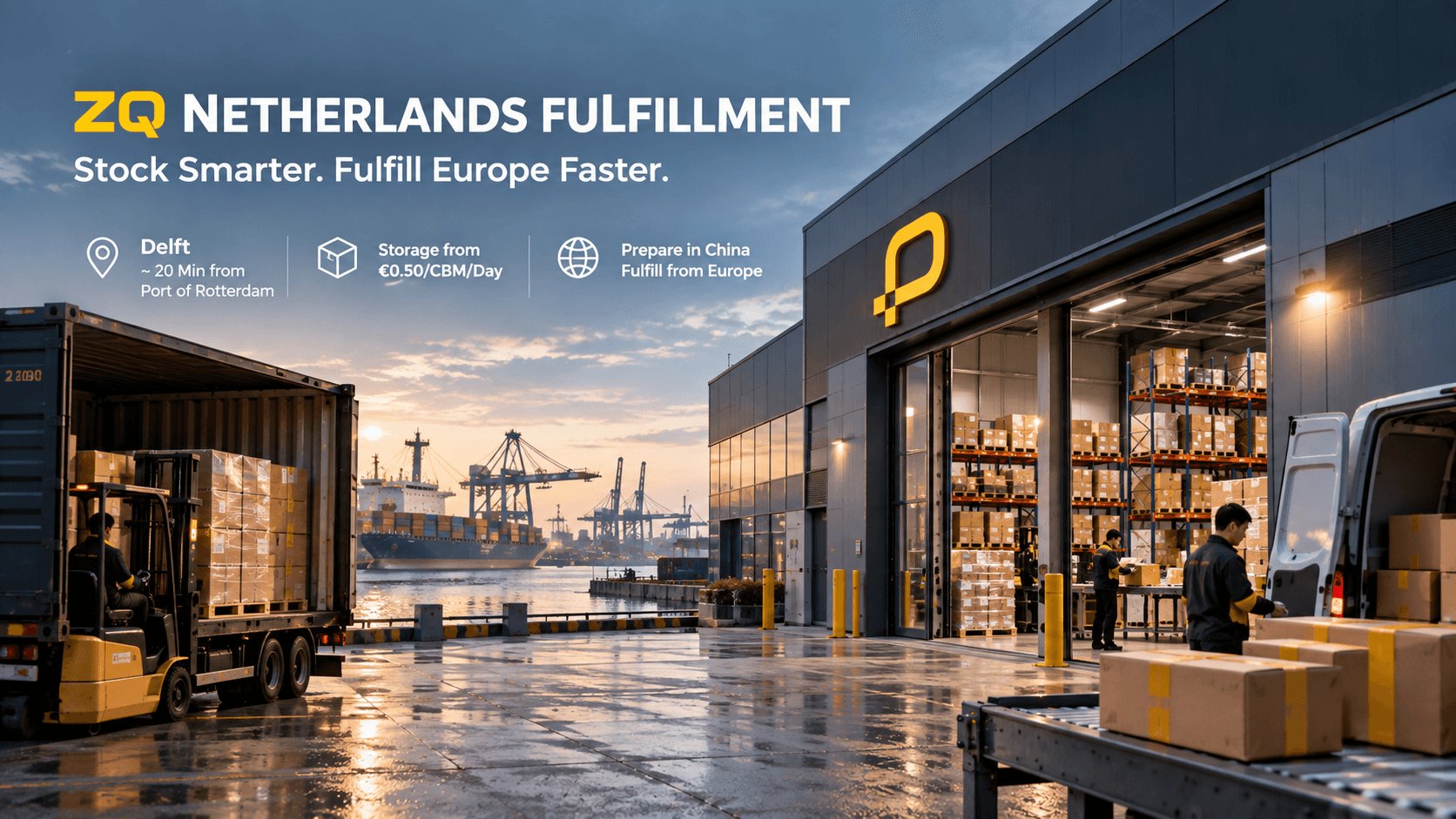
ZQ has added a Netherlands warehouse, giving cross-border sellers more ways to fulfill European orders. An overseas warehouse can make European fulfillment faster and delivery more predictable, but it can also tie up cash in slow-moving inventory. The right choice depends on market demand, inventory turnover, and the full fulfillment cost per order.
This guide compares ZQ's Netherlands fulfillment center with direct dropshipping from China. It explains the fees, delivery advantages, inventory risks, and the types of products that suit each model. It also shows how sellers can combine ZQ's China and Netherlands warehouses instead of forcing every SKU into one fulfillment route.
Quick answer
Use direct dropshipping to test new products and serve low-volume SKUs. Move proven products to the Netherlands when demand is stable enough to support advance inventory. For many sellers, the best option is a hybrid model.
What Is the ZQ Netherlands Fulfillment Center?
The ZQ Netherlands fulfillment center stores imported inventory and ships individual orders to European customers. It can receive stock, manage inventory, pick and pack orders, hand parcels to carriers, and process agreed returns or value-added services.
Products first move from China to the Netherlands in bulk. After the inventory is stored, each customer order is fulfilled from the Netherlands through a local or regional parcel network.
Why Sellers Are Reconsidering Direct EU Shipping in 2026
Direct shipping still works, but sellers now pay closer attention to its full cost, packaging control, and delivery stability.
Import costs must be calculated correctly
Direct parcels and bulk warehouse inventory use different import structures, but neither route removes customs, duty, or VAT obligations. Sellers need to include the applicable import costs instead of comparing shipping prices alone.
PPWR makes packaging control more important
PPWR does not require sellers to use an EU warehouse. It does make consistent packaging specifications, documentation, and packaging operations more important. A prepared inventory batch is easier to control, and agreed relabeling or repacking can be completed where required.
An overseas warehouse does not make a product or package automatically compliant. Product compliance, importer duties, EPR, tax, and packaging responsibilities still depend on the seller's setup and role. However, the Netherlands warehouse can replace packaging and provide labeling or relabeling services according to the seller's approved PPWR requirements. Sellers can review ZQ's PPWR compliance guide for cross-border ecommerce for more detail.
Delivery is harder to control from one distant stock point
With direct shipping, every order begins an international journey after checkout. Customs handoffs, transport capacity, and peak-season congestion can affect the delivery window.
Pre-positioned inventory removes that international leg from the customer-order timeline. Carrier and processing risks remain, but delivery estimates are easier to manage from a European stock point.
ZQ Dropshipping vs ZQ Netherlands Warehouse
Neither model wins in every situation. Direct dropshipping protects cash flow and product flexibility. The Netherlands warehouse gives up some flexibility in exchange for faster access to European customers and greater control over repeat fulfillment.
| Decision factor | ZQ Dropshipping from China | ZQ Netherlands warehouse |
|---|---|---|
| Inventory | Source or fulfill after an order | Purchase and import stock in advance |
| Product testing | Low inventory exposure | Higher risk before demand is proven |
| Customer delivery | Includes an international route | Starts from an EU stock point |
| Cash flow | Less cash tied to stock | Cash committed before sales |
| Cost structure | Direct parcel and handling cost per order | Inbound, storage, handling, and delivery costs |
| Returns | Cross-border returns can be difficult | Local return inspection is available |
| Labeling | Can be completed in China | Can be prepared in China or handled in the Netherlands |
| Best fit | New, long-tail, or unstable SKUs | Proven SKUs with stable EU demand |
ZQ Dropshipping charges a sourcing fee of 0%–7% of the total product purchase amount, depending on the customer's account level. Shipping is quoted according to the product, destination, and route.
When Can a Netherlands Warehouse Lower the Cost per Order?
A Netherlands warehouse is not automatically cheaper. It becomes competitive when bulk transport and regional fulfillment benefits exceed storage, handling, delivery, and inventory costs.
The product sells quickly
Fast turnover reduces the number of storage days charged to each unit and releases the cash invested in inventory sooner.
Slow inventory creates the opposite result. Storage continues while the product produces no revenue. Disposal, removal, or long-term storage can erase the saving gained from bulk transport.
The product suits bulk transport
Consolidated freight can spread international transport costs across more units. The result depends on shipment size, product weight, volume, packing density, and transport mode.
Small or irregular shipments may not create enough scale. Sellers should use a real headhaul quote instead of assuming bulk transport will always cost less.
EU orders are concentrated in suitable markets
A Netherlands warehouse works best when a meaningful share of orders can be served efficiently from that location. Rates still vary by destination and carrier zone.
A parcel sent from the Netherlands to Germany, France, Spain, or Italy is an intra-EU cross-border shipment, not a Dutch domestic shipment.
Returned products still have resale value
Local inspection, repacking, and refurbishment can recover value when a returned product is suitable for resale. This matters most when the product value justifies the return and warehouse handling costs.
The Main Disadvantages of Overseas Warehousing
Cash is committed before customers buy
The seller pays for products, bulk transport, import costs, and warehouse intake before recovering the money through sales.
Forecasting errors become physical inventory
An advertising campaign can stop performing, a trend can fade, or a listing can be suspended. Any of these can leave stock in Europe without enough orders to clear it.
Every extra warehouse touch costs money
Counting, sorting, relabeling, repacking, inspection, and refurbishment all generate fees. Products should be prepared correctly before they reach the Netherlands whenever possible.
One warehouse does not make all of Europe local
The Netherlands is a useful European distribution point, but rates and delivery times still vary by country and carrier zone. Sellers should request last-mile quotes for their main customer markets.
The Main Advantages of Overseas Warehousing
Faster, more predictable fulfillment
With direct dropshipping, each order begins an international journey after checkout. With Netherlands stock, the international movement happens before the customer orders. Delivery still depends on the carrier and destination, but the customer order starts closer to the European market.
Better control over repeat orders
A prepared inventory batch can use consistent SKU labels, packaging instructions, and fulfillment procedures. This is useful after a product has moved beyond the testing stage.
Local returns and corrective services
The Netherlands warehouse can inspect returns and carry out agreed relabeling, repacking, refurbishment, or disposal. These services create a local recovery option, although every operation has a fee.
Support for multichannel fulfillment
Sellers can use the warehouse for ecommerce orders that require inventory closer to European customers. If a platform label or outside logistics service is used, the warehouse-carrier separation surcharge in the rate card may apply.
Which Products Should You Stock in the Netherlands?
Stock products based on sales evidence, not optimism.
Good candidates usually have:
- Predictable EU sales
- Stable suppliers and product specifications
- Low return or defect rates
- Enough margin to cover warehouse operations
- Efficient use of storage space
- A replenishment cycle the seller can plan
Keep direct dropshipping for products with:
- No proven sales history
- Seasonal or trend-driven demand
- Many low-volume variants
- Frequent supplier or specification changes
- High storage volume relative to product value
- Unresolved compliance questions
A Dual-Warehouse Hybrid Fulfillment Strategy
Sellers do not need to place the whole catalog in one fulfillment model. A hybrid strategy keeps uncertain products in China and moves stable demand closer to European customers.
- Test new SKUs through ZQ Dropshipping.
- Track EU sales, cancellations, returns, and margin.
- Set a maximum stock level and replenishment point.
- Move a controlled batch of proven inventory to the Netherlands.
- Keep low-volume variants in China.
- Review stock age before every replenishment.
The Netherlands warehouse does not need to hold every color, size, or experimental product. It can focus on the SKUs that generate repeat orders.
How ZQ's China Warehouse Reduces Netherlands Handling
European warehouse fees increase every time stock needs to be counted, sorted, relabeled, repacked, or corrected. ZQ can complete suitable preparation before the goods leave China.
ZQ's China warehouse charges US$0.20 per item for labeling or relabeling. The Netherlands bulk relabeling rate is €0.50 per item up to 30 kg, €1 from 30–68 kg, and €2 above 68 kg.
Completing suitable work in China can reduce unnecessary warehouse operations after arrival. The Netherlands warehouse can then focus on receiving, storage, order handling, delivery handoff, and returns.
The US$0.20 rate covers labeling or relabeling only. Inspection, sorting, packaging materials, and other preparation require separate confirmation.
ZQ Netherlands Warehouse Fees
The following rates come from the Netherlands warehouse price schedule effective August 10, 2026. They are warehouse operating fees, not a complete delivered price. Headhaul, import charges, packaging materials, and final delivery require separate quotations.
| Service | ZQ Netherlands warehouse rate | Notes |
|---|---|---|
| 20GP container unloading | €400/container | Fewer than 1,000 cartons; excess cartons €2.10 each |
| 40GP or 40HQ container unloading | €500/container | Per container |
| 45HQ container unloading | €550/container | Per container |
| LCL or loose-carton unloading | €2/carton | An unidentifiable inbound carton adds €2/carton |
| Pallet intake | €10/pallet | Standard pallet: 1.2 × 1 × 1.8 m |
| SKU-type surcharge | €5/SKU type | Applies when one inbound order contains more than five SKU types; sorting excluded |
| Inbound putaway | €0.20–€8/item | Based on billable weight |
| Storage | €0.50–€2.50/CBM/day | Based on stock age; minimum 0.001 CBM/item |
| Standard one-item order handling | €0.30–€12/order | Based on billable weight |
| Warehouse-carrier separation surcharge | €0.80–€7/order | Applies when the designated back-end logistics service is not used; delivery excluded |
| Rebagging | €0.20/order | Materials excluded |
| Reboxing | €0.40/carton | Materials excluded |
| Return intake and quick inspection | €2–€10/item | No advance notice adds €2/carton |
| Defective-item refurbishment | €1.50–€8/item | Materials excluded |
| Bulk relabeling | €0.50–€2/item | Based on weight |
Billable weight is the greater of actual weight and volumetric weight. Volumetric weight is calculated as length × width × height ÷ 6000.
| Stock age | Storage rate |
|---|---|
| Days 1–30 | €0.50/CBM/day |
| Days 31–90 | €1/CBM/day |
| Days 91–180 | €1.50/CBM/day |
| Days 181–360 | €2/CBM/day |
| More than 360 days | €2.50/CBM/day |
From November through January, an additional €0.50/CBM/day applies.
The workbook lists optional value-added services separately in USD, including inventory counting at $1/item, sorting at $0.30/item, SKU labeling at $0.50/label, photography at $1/photo, product measurement at $5/SKU, and special work at $40/person/hour. These fees apply only when the service is requested or triggered.
Frequently Asked Questions
Where Is ZQ Solution's Netherlands Warehouse, and How Is Inventory Protected?
ZQ Solution's Netherlands warehouse is located in Delft, approximately a 20-minute drive from the Port of Rotterdam, the largest port in the Netherlands. This location shortens the road journey from the port to the warehouse and supports efficient receiving, putaway, and order fulfillment.
The warehouse is surrounded by security fencing, and stored inventory is insured to reduce the risk of losses caused by unexpected incidents. Insurance coverage and compensation are subject to the applicable policy and warehouse service agreement.
What is the realistic break-even point for the ZQ Netherlands warehouse?
There is no fixed monthly order number for every SKU. Break-even depends on sales speed, packed volume, margin, inbound transport, destination mix, and returns.
The lowest storage rate applies during the first 30 days. Planning the first batch around approximately 15–30 days of supported demand can help control risk, but the quantity should come from real sales history and replenishment time.
Which costs sit outside the storage rate?
A complete calculation may include unloading, SKU surcharges, putaway, storage, order handling, packaging, delivery, returns, relabeling, reboxing, and optional value-added services.
Headhaul, customs and tax charges, packaging materials, and final delivery are not included in the warehouse operating table and require separate quotations.
How can ZQ's China warehouse reduce European warehouse fees?
ZQ can complete suitable labeling or relabeling in China for US$0.20 per item before the bulk shipment. This can reduce the need to pay Netherlands relabeling rates of €0.50–€2 per item.
Other China-side preparation services and materials require confirmation. Some work may still need to be completed after arrival, depending on the product and destination.
What happens when inventory arrives without the correct preparation?
The price schedule requires an inbound order and identifiable labels. Loose cargo received without an inbound task or scannable inbound label adds €2/carton. The separate USD value-added schedule lists unreported sea or air inbound orders at $20/order and missing or incorrect product forecast data at $2/item.
Incorrect preparation may also delay receiving. Sellers should confirm the inbound requirements before the shipment leaves China.
Can one Netherlands warehouse serve every EU country at a domestic rate?
No. Delivery prices and times vary by destination, carrier, parcel size, and service zone.
When a seller uses a platform label or another non-designated back-end logistics service, the rate card adds a warehouse-carrier separation surcharge of €0.80–€7/order by weight. Delivery is not included in that surcharge.
Can sellers combine ZQ Dropshipping with the Netherlands warehouse?
Yes. New and low-volume products can continue shipping directly from China while proven products are stocked in the Netherlands. This reduces inventory exposure without giving up faster regional fulfillment for established sellers.
The practical choice is not overseas warehouse or dropshipping for the whole store. It is the right fulfillment route for each SKU.
To compare both options, send ZQ the product's packed weight and dimensions, planned inbound quantity, and main European delivery countries. ZQ can provide the missing transport and delivery quotations for a real cost comparison.