
EU PPWR 2026: Packaging Compliance for Cross-Border Sellers

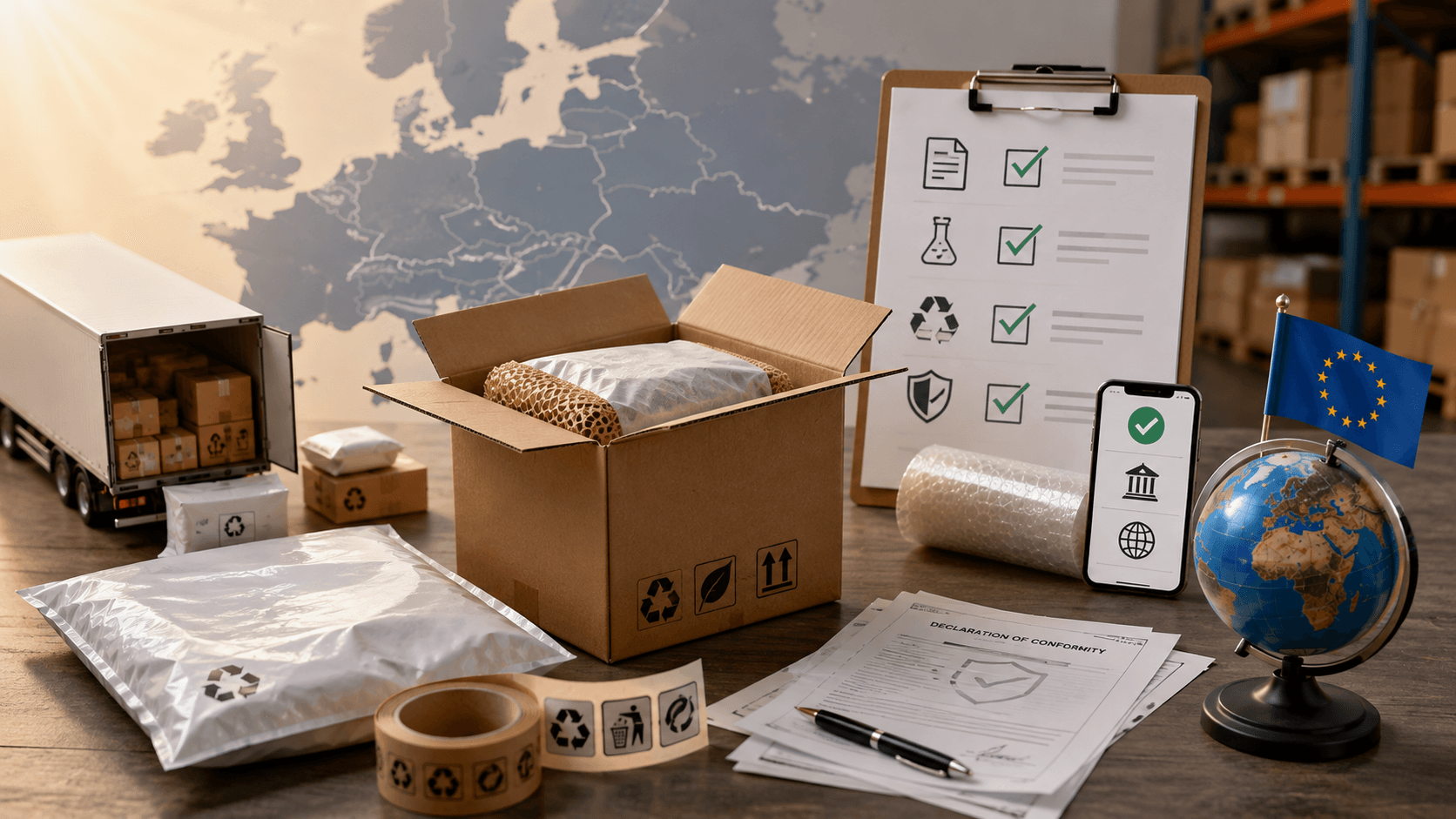
Reviewed September 21, 2026. This version separates the PPWR provisions already applicable in 2026 from later deadlines. It also removes broad claims that a warehouse or freight route can make a seller compliant automatically.
What is the EU PPWR, and when did it start?
The Packaging and Packaging Waste Regulation, Regulation (EU) 2025/40, applies from August 12, 2026. It covers all packaging and packaging waste regardless of material. It introduces EU-wide rules for packaging sustainability, labeling, minimization, reuse, and extended producer responsibility, but the obligations phase in on different dates.
The correct compliance question is not simply, “Is PPWR in force?” The practical question is, “Which obligation applies to this packaging, this seller role, this destination country, and this date?”
Which PPWR requirements apply now, and which start later?
| Requirement | Main date | What sellers should do now |
|---|---|---|
| PPWR general application | August 12, 2026 | Map the packaging manufacturer, importer, distributor, producer, and fulfillment-provider roles for each sales flow |
| Packaging EPR registration and reporting | Country-specific systems continue under the PPWR framework | Identify every country where the seller first makes packaged goods available and verify the applicable register, representative, PRO, and reporting rules |
| Harmonised EU material-composition label | August 12, 2028, or 24 months after the relevant implementing acts enter into force, whichever is later | Do not claim that one EU label has already replaced all national instructions; retain destination-specific label checks |
| Recyclability performance grades | January 1, 2030, or the later trigger stated in Article 6 | Collect packaging specifications and supplier evidence before the deadline |
| Maximum 50% empty-space ratio for grouped, transport, and e-commerce packaging | January 1, 2030 | Reduce unnecessary void space now because it also reduces freight and storage cost |
A common error is to move the 2028 or 2030 obligations forward and present them as immediate August 2026 rules. Another error is to assume that national packaging and sorting requirements disappeared on August 12, 2026. Transitional provisions and country systems still matter.
Who is responsible when a non-EU seller uses an EU warehouse?
A warehouse location does not transfer the seller's legal obligations by itself. PPWR assigns obligations according to defined economic roles and the way packaged goods are first made available in a Member State. The producer may need registration and EPR arrangements in the relevant country. A non-EU producer may also need an authorised representative for EPR according to Article 45 and the destination-country setup.
A fulfillment service provider has its own verification duties. Article 45 requires producers to provide the fulfillment provider with their registration information and self-certification when the contract is concluded. If required information is missing or inaccurate and is not corrected after a request, the fulfillment provider may have to suspend the affected service.
ZQ Solution's Delft warehouse is therefore a fulfillment location, not a substitute for the seller's EPR registration, authorised representative, packaging manufacturer documentation, or legal advice.
How can ZQ support PPWR preparation without overstating its role?
ZQ can support the physical and data work that makes the seller's compliance process easier to execute:
- Supplier and SKU records in China. ZQ can link incoming products to supplier, SKU, quantity, and receiving records before consolidation.
- Packaging inspection. The Shenzhen warehouse can record visible packaging format and follow agreed inspection instructions. Laboratory testing and legal conformity assessment remain separate professional work.
- Repacking and labeling. ZQ can remove unnecessary outer packaging, change cartons, or apply seller-approved labels and inserts before export. ZQ does not decide which legal label is required.
- Packing data. ZQ can provide packed quantities, carton dimensions, weights, and selected packaging records for freight and seller reporting workflows.
- Delft rework. If goods have already reached Europe, the Delft warehouse can perform agreed relabeling, repacking, inspection, and local-return handling. Complex repair work is priced case by case.
The seller or appointed compliance adviser must provide the final packaging specification, label artwork, registration numbers, responsible-person information, and product-specific instructions.
Why does a China-to-Delft workflow help with packaging control?
Direct dropshipping leaves little time between a supplier dispatching a product and the parcel entering the EU. A consolidated China-to-Delft workflow creates two physical control points before the consumer order is delivered:
| Control point | Available work | Business value |
|---|---|---|
| ZQ Shenzhen warehouse | Receive from multiple suppliers, inspect to an agreed checklist, label, repack, consolidate, and create carton data | Catches visible packaging issues before international freight |
| ZQ Delft warehouse | Receive bulk inventory, put away stock, perform approved rework, fulfill local orders, and process returns | Keeps corrective work and resaleable returns inside Europe |
This workflow does not “avoid PPWR.” It gives the seller a more controlled place to apply its approved packaging specification and retain operational records.
Does bulk importing to Delft solve the 2026 €3 parcel duty?
The 2026 temporary €3 duty applies to low-value e-commerce consignments imported from outside the EU. Inventory imported in a consolidated commercial shipment follows the normal import process first. Consumer orders later dispatched from goods already in EU free circulation do not create a new low-value import event at the external border.
That distinction can improve the economics of proven SKUs, but bulk importing still requires the correct customs value, tariff classification, import duty, import VAT, documentation, and Importer of Record arrangement. ZQ is not a customs broker. Clearance, DDP, and tax work is handled by qualified logistics partners according to the route and buyer setup.
See the EU €3 small-parcel duty and Netherlands warehouse guide and the real Delft cost comparison.
What should sellers prepare before sending inventory to Delft?
Use this handoff checklist for each SKU:
- Product name, SKU, supplier, country of origin, and HS-code review status.
- Packaging manufacturer or supplier details and available technical documentation.
- Packaging materials and approximate weight by material where required for EPR reporting.
- Destination-country EPR registration details and authorised-representative status where applicable.
- Required consumer-language instructions, warnings, responsible-person information, and product labels.
- Approved repacking, relabeling, and carton instructions for Shenzhen and Delft.
- VAT, importer, and customs arrangements for the bulk movement.
- Rules for quarantine, rework, resale, return, or destruction when stock fails the checklist.
Do not send a container or air shipment first and try to reconstruct the compliance file after arrival. Physical rework is possible, but missing legal documentation may still block sale or marketplace listing.
How does PPWR relate to GPSR, VAT, and product-specific EPR?
PPWR regulates packaging. It does not replace other EU rules.
- GPSR governs general product safety and requires specific product, manufacturer, responsible-person, and warning information for distance-sale offers where applicable.
- VAT and customs govern tax and import treatment. Packaging registration does not create an IOSS, OSS, VAT, or importer setup.
- WEEE, batteries, textiles, and other product regimes may add separate producer-responsibility or product requirements. Packaging EPR does not satisfy those regimes.
A seller should maintain one SKU-level compliance file that separates product safety, packaging, tax, customs, and marketplace fields instead of treating “EU compliance” as one certificate.
Frequently Asked Questions
Does ZQ's Delft warehouse make my packaging PPWR-compliant?
No. ZQ can perform agreed packaging, labeling, inspection, and data tasks. The seller remains responsible for determining the applicable rules and supplying approved instructions and documentation.
Is the EU harmonised recycling label already mandatory?
Not as a blanket August 2026 requirement. Article 12 sets the harmonised material-composition label for August 12, 2028, or 24 months after the relevant implementing acts enter into force, whichever is later. National instructions and transition rules still require checking.
Does the 50% empty-space limit apply in 2026?
No. The PPWR's maximum 50% empty-space ratio for grouped, transport, and e-commerce packaging starts from January 1, 2030. Packaging minimization work is still sensible now because it reduces freight and storage volume.
Can ZQ register EPR or act as the authorised representative?
ZQ's public service is sourcing, inspection, consolidation, freight preparation, and warehouse fulfillment. Do not assume that a ZQ warehouse contract includes EPR registration, a producer-responsibility organisation contract, an authorised representative, customs brokerage, or tax advice unless a separate qualified provider is named in writing.
Where can I check whether I need EPR registration in each country?
Start with the seller's role and destination markets, then use the country-by-country EPR and PPWR guide as a working map. Final registration decisions should be checked against the official national register or a qualified compliance adviser.