
Do Ecommerce Sellers Need Packaging EPR in Every EU Country?

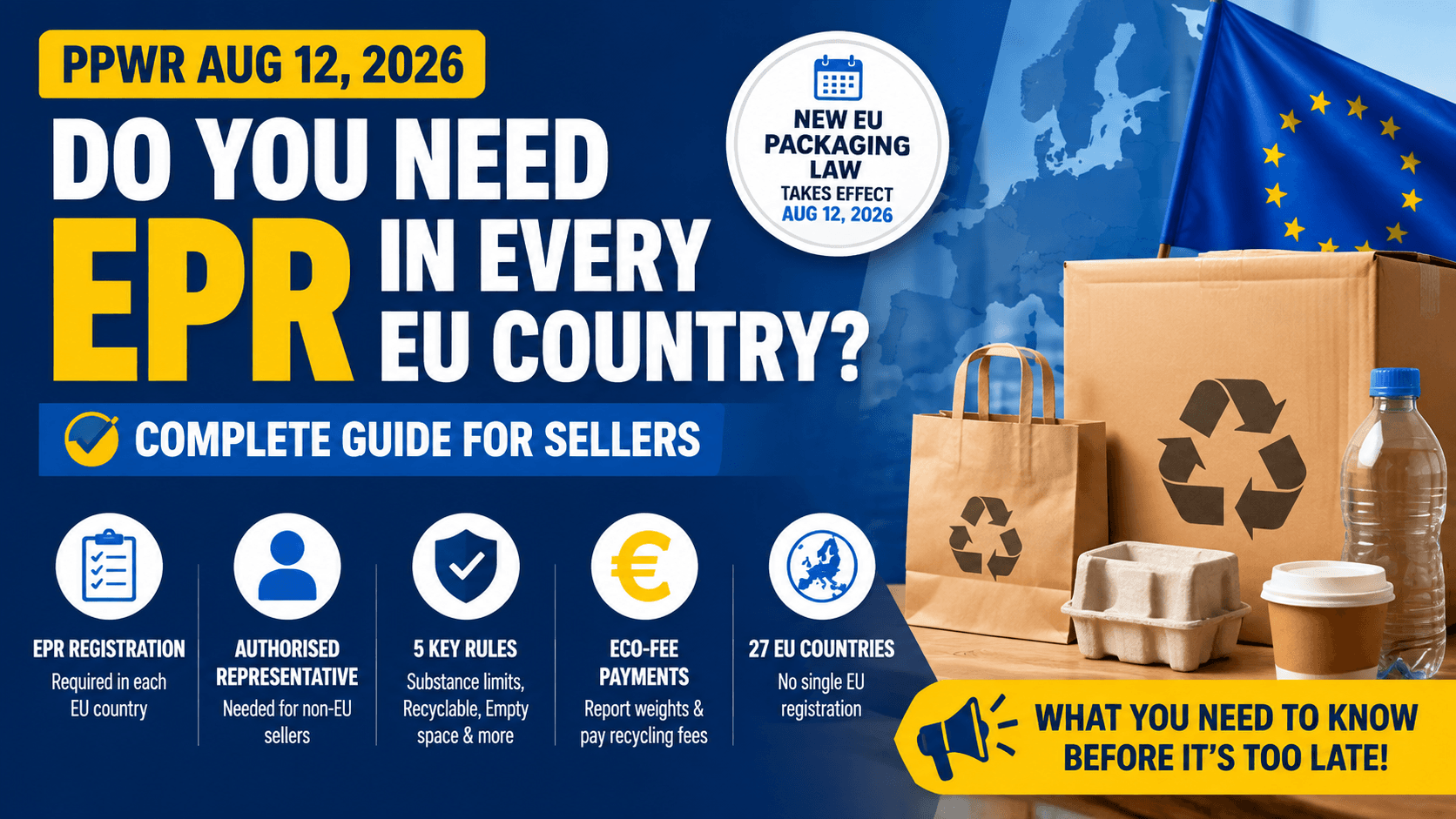
Reviewed September 21, 2026. This article now distinguishes the EU-wide PPWR rules from country-level producer registration, reporting, and fee systems. Unverified fee examples and blanket exemptions have been removed.
Do sellers need one packaging EPR registration or several?
There is no single EU-wide packaging EPR registration number. Regulation (EU) 2025/40 creates a common PPWR framework, but producers register in the packaging register of each Member State where they are required to register. National producer-responsibility organisations, reporting calendars, fees, language, and marketplace checks can differ.
For distance sales, the answer often follows the consumer's country. PPWR treats an economic operator established in another Member State or in a third country as the producer when it makes packaging or packaged products available directly to end users in that Member State through distance contracts. Article 44 requires a producer to register in each Member State where it first makes packaging or packaged products available.
That means a non-EU Shopify seller shipping packaged goods directly to consumers in Germany, France, and Spain should not assume that one Dutch or German packaging number covers all three markets. The exact responsible party can change when a marketplace acts on behalf of the seller, when another importer or distributor first places the goods on the market, or when a written mandate reallocates a permitted task. Map the legal roles before registering.
Does a Netherlands warehouse create one registration for all EU sales?
No. Storing stock at ZQ's Delft warehouse does not convert a Dutch registration into an EU-wide registration. The warehouse is a fulfillment location. The seller still needs to identify who is the producer, where the packaged goods are first made available, where consumers are located, and what each national system and marketplace requires.
Delft stock can simplify operations by creating one controlled inventory point for local dispatch, returns, repacking, and labeling. It does not replace EPR registration, an authorised representative, a producer-responsibility organisation contract, VAT registration, OSS reporting, product-safety obligations, or an Importer of Record.
Who is the producer under PPWR for a distance sale?
PPWR uses “producer” as a legal role, not as a synonym for the factory that made the cardboard box. For packaged goods sold through a distance contract, the producer can be the seller established in another EU country or outside the EU that first makes the packaged product available to an end user in the destination Member State.
The packaging manufacturer has separate duties, including technical documentation and the EU declaration of conformity for packaging within its responsibility. The seller should collect the documentation it needs from the packaging supply chain, but paying a box supplier does not automatically satisfy the seller's EPR registration and reporting duties.
When does a non-EU seller need an authorised representative?
Article 45 requires certain producers making distance sales from another Member State or a third country to appoint an authorised representative for EPR in each Member State where the producer makes packaging available, other than the Member State where it is established. The appointment must be made by written mandate.
An EPR authorised representative is not automatically the same entity as a customs representative, Importer of Record, GPSR responsible person, tax representative, warehouse, or carrier. One company may offer several services under separate contracts, but the roles should never be assumed from a logistics address.
What information can a marketplace or fulfillment provider request?
Under Article 45, an online marketplace that allows EU consumers to conclude distance contracts with producers must obtain the producer's registration information and a self-certification before allowing the producer to use the service. A fulfillment service provider must receive the same information when it contracts with the producer.
If the information is missing or inaccurate, the marketplace or fulfillment provider must ask the producer to correct it. If the producer does not correct it, the affected service may be suspended. This is why EPR is becoming an account and fulfillment requirement, not only an annual environmental report.
Which country systems should a seller check first?
The table below is a starting map, not a substitute for checking the current official rules and eligibility in each market. Some links are public registers; others are recognised producer-responsibility organisations that administer fees and reporting.
| Market | Starting point | What to verify |
|---|---|---|
| Germany | LUCID packaging register | Registration, system-participation contract, packaging volumes, marketplace number |
| France | SYDEREP and Citeo | Producer ID, PRO membership, declarations, consumer sorting information |
| Spain | MITECO packaging information | Producer register, representative, PRO, reporting |
| Italy | CONAI | Responsible party, registration, contribution and labeling rules |
| Netherlands | Verpact | Reporting threshold and scope, packaging administration, seller establishment |
| Poland | BDO register | Registration, representative, records and annual reporting |
| Belgium | Fost Plus and Valipac | Household versus commercial packaging, membership and reporting |
| Ireland | Repak | Producer status, membership route, reporting and fees |
For other EU countries, begin with the national environmental authority or packaging register rather than an unofficial “EU-wide EPR certificate” seller.
What should sellers record for packaging EPR reporting?
A workable packaging-data file separates each material and packaging level. Record at least:
- Sales packaging that reaches the consumer, such as a product box, bottle, pouch, or protective insert.
- Grouped packaging used to combine sale units.
- Transport and e-commerce packaging, including cartons, mailers, tape, void fill, and labels where the national system includes them.
- Material category and weight for each component.
- Units sold or dispatched to each country during the reporting period.
- Registration number, PRO contract, authorised representative, filing date, and supporting invoices for each country.
ZQ can provide agreed receiving, repacking, carton, weight, and dispatch records from Shenzhen and Delft. ZQ does not calculate the seller's legal packaging declaration unless that work is separately contracted to a qualified provider.
How does the ZQ Shenzhen-to-Delft workflow support EPR operations?
The China warehouse can receive goods from multiple suppliers, remove redundant supplier shipping layers, repackage products to approved instructions, and consolidate bulk freight. The Delft warehouse can fulfill European orders, receive returns, and perform agreed relabeling or repacking work.
This two-stage workflow can make packaging data more consistent because the seller can approve one packing specification before bulk import and retain a separate record for local outbound packaging. It also helps distinguish the packaging imported with the inventory from the packaging added by the European fulfillment operation.
For the physical workflow, read ZQ Delft warehouse fulfillment for Amazon, TikTok Shop, and TEMU. For the legal and operational PPWR timeline, read the EU PPWR 2026 compliance guide.
EPR, VAT, customs, and GPSR are different workstreams
| Workstream | Main question | A Delft warehouse replaces it? |
|---|---|---|
| Packaging EPR | Who reports and pays for packaging placed on each national market? | No |
| PPWR product-packaging compliance | Does the packaging meet applicable material, documentation, labeling, and minimization rules? | No; ZQ can execute approved physical instructions |
| VAT and OSS | Who charges and reports VAT on the sale? | No |
| Customs and Importer of Record | Who imports the bulk inventory and pays import charges? | No |
| GPSR and product rules | Is the product safe, traceable, labeled, and represented correctly in the EU? | No |
| Fulfillment | Who stores, picks, packs, dispatches, and handles returns? | Yes, this is the warehouse function |
Keeping these workstreams separate prevents the common mistake of buying one logistics service and assuming that all EU compliance roles have been transferred.
Frequently Asked Questions
If I sell to only one EU country, can one packaging registration be enough?
Potentially, if that is the only Member State where the business makes packaged goods available and no other stock or sales flow changes the role map. Confirm the national rules, marketplace requirements, and authorised-representative obligation for that country.
If I use Pan-European FBA, do I automatically need five EPR numbers?
Do not use a fixed number without mapping the actual storage, transfer, sale, and producer roles. Amazon may require country-specific numbers for the markets and programs used. Check Seller Central and the official national registers against the seller's real inventory flow.
Can ZQ be my EPR authorised representative?
Do not assume so. ZQ's public warehouse service covers sourcing support, receiving, inspection, consolidation, packing, fulfillment, and returns. An EPR authorised-representative mandate or PRO contract must be agreed separately with a qualified provider.
Does EPR registration prove that the product itself is legal to sell?
No. Packaging EPR covers producer responsibility for packaging waste. Product safety, GPSR information, CE or sector rules, batteries, WEEE, VAT, customs, and marketplace rules are separate.
Does local Delft fulfillment remove the €3 small-parcel duty?
Goods already imported into EU free circulation do not cross the external EU border again for each consumer order. The earlier bulk import still has normal customs, VAT, documentation, and importer requirements. See the EU €3 duty and Delft strategy guide.