
Bol.com Fulfillment in the Netherlands: A 3PL Guide for Dutch and Belgian Sellers

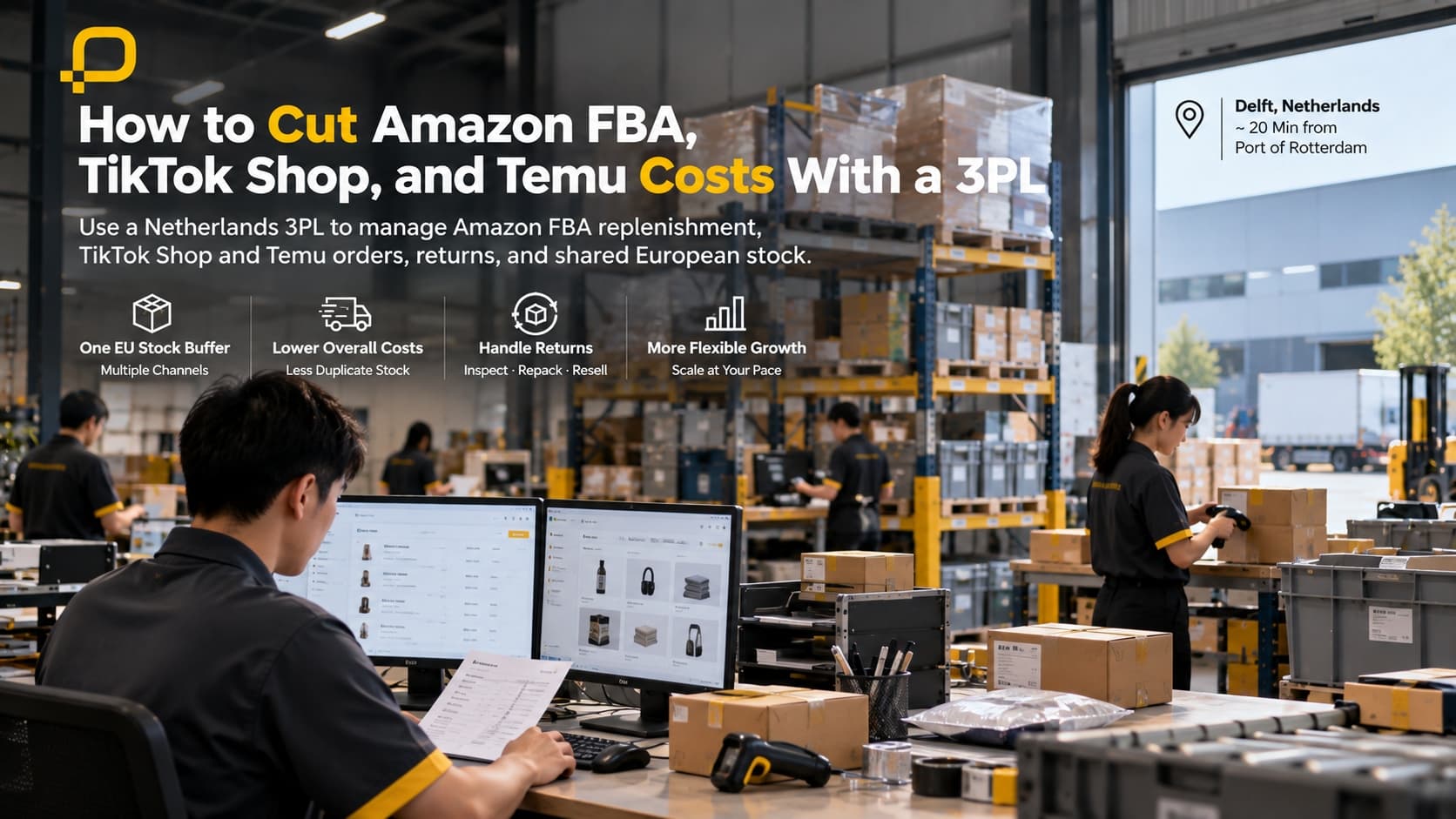
Reviewed September 24, 2026. ZQ Solution provides local 3PL fulfillment for bol sellers from its self-operated warehouse in Delft, the Netherlands. ZQ can receive inventory from China, Korea, the Netherlands, Belgium, and other EU locations, then store, pick, pack, dispatch, and process returns for Dutch and Belgian orders.
ZQ is currently a 3PL for bol sellers, not a bol-certified 3PL partner. Direct integration with the bol Retailer API is under development and is planned for November 2026. Until the integration is live, the seller remains responsible for marketplace customer service, cancellations, and refund decisions.
Quick answer
ZQ's Delft warehouse is best suited to bol sellers that want Dutch inventory control, local delivery and returns, or one fulfillment point for bol and other sales channels. Its main difference from a warehouse-only 3PL is the upstream option: ZQ can also coordinate China or Korea sourcing, inspection, labeling, small-batch consolidation, and transport to Delft.
Why do bol sellers use a 3PL in the Netherlands?
A Netherlands 3PL stores inventory near Dutch and Belgian customers and performs the physical work after an order is placed. This can remove daily picking, packing, label printing, carrier handoff, and return receiving from the seller's own operation.
Bol lists Third Party Logistics as one of its logistics models. Bol says a 3PL can suit sellers that want to fulfill several sales channels from one warehouse or need specialist warehouse capabilities. This is different from Logistiek via bol, where bol takes over storage, shipment, delivery questions, and returns. See bol's official logistics options.
A local warehouse does not automatically improve a bol account. The warehouse process, carrier service, inventory accuracy, tracking data, and delivery promise must work together.
Which bol fulfillment model fits each seller?
| Fulfillment model | Inventory and packing | Delivery setup | Main reason to choose it |
|---|---|---|---|
| Logistiek via bol | Bol stores and packs eligible inventory | Bol manages the logistics service | The seller wants bol to take over most operational logistics |
| Verzenden via bol | The seller or its warehouse stores and packs inventory | The seller uses the applicable bol shipping workflow | The seller wants inventory control with a bol delivery solution |
| External 3PL | The 3PL stores and packs inventory | Seller-supplied labels or the 3PL's carrier routes | The seller needs multi-channel stock, custom work, or an independent warehouse |
| Self-fulfillment | The seller stores and packs inventory | The seller arranges the carrier | The seller has the staff, space, and systems to run fulfillment internally |
ZQ's Delft warehouse is an external 3PL. ZQ should not be described as Logistiek via bol, a bol-certified 3PL, or an official bol logistics partner unless that status changes.
What should a bol seller check before choosing a 3PL?
A bol seller should verify the order handoff, label process, dispatch cut-off, tracking update, return address, stock controls, peak-season capacity, and exception process before moving inventory.
Delivery performance is measurable on bol. Bol's current service guidance lists a 90% minimum for items on time, with targets of 93% for on-time delivery and 95% for on-time carrier handover under the relevant shipping method. Bol also advises sellers to keep stock accurate and mark orders as shipped with Track & Trace. Read bol's Artikelen op tijd service standard.
A useful 3PL review should therefore answer:
- How does the warehouse receive a new bol order?
- Who creates the shipping label?
- When does the warehouse stop accepting same-day work?
- When is the order marked as shipped?
- How is Track & Trace returned to bol?
- What happens after a cancellation or address problem?
- Which warehouse receives Dutch and Belgian returns?
- How are returned units graded and returned to stock?
What can ZQ's Delft 3PL handle for bol sellers today?
ZQ's Delft warehouse can receive seller-owned inventory from Asia or within the EU. The Delft team can unload and receive stock, put it away, store it, pick and pack orders, print approved shipping labels, hand parcels to the selected carrier, and receive returns.
The current service boundary is:
| Task | Current responsibility |
|---|---|
| Store and physically fulfill inventory in Delft | ZQ |
| Print a bol or Verzenden via bol label supplied by the seller | ZQ |
| Supply a label when the seller does not provide one | ZQ, through an available partner-carrier route |
| Bol customer service | Seller |
| Approve cancellations and refunds | Seller |
| Receive and physically process returns in Delft | ZQ, at the applicable return-handling rates |
| Direct bol Retailer API order and tracking connection | In development, planned for November 2026 |
| Bol-certified 3PL partner status | Not currently held |
A planned launch date is not a live integration. Sellers onboarding before the bol Retailer API connection goes live must agree on the current order, label, and tracking handoff before sending stock.
How does the ZQ bol fulfillment workflow operate before the API launch?
- Prepare inventory. The seller supplies SKU, barcode, packaging, inbound, and delivery instructions.
- Send stock to Delft. Inventory can arrive from China, Korea, the Netherlands, Belgium, or another EU location.
- Receive and put away. ZQ matches the physical goods to the inbound records and stores available inventory.
- Send the order and label. Before direct API integration is live, the seller provides the order data and any bol or Verzenden via bol label through the agreed workflow.
- Pick, pack, and dispatch. ZQ prepares the parcel and hands it to the applicable carrier.
- Update the marketplace. The seller remains responsible for the bol account and marketplace actions under the agreed pre-integration workflow.
- Handle returns. Delft receives registered returns and performs the approved inspection, restock, repack, repair, or disposal instruction.
After the planned API connection is released, this section should be updated only after its live order, inventory, cancellation, shipment, and tracking functions have been tested.
How fast can ZQ dispatch Dutch and Belgian bol orders?
During regular operations, a complete standard order received before 12:00 local European time can leave the Delft warehouse on the same working day. The stock, address, label, and work instructions must all be ready. During peak periods, warehouse processing adds 24 hours and the 12:00 cut-off remains unchanged.
The current carrier schedules use a planning range of 1–2 business days for the Netherlands and Belgium after warehouse handoff. This is not a blanket next-day guarantee. Carrier collection, postcode, service type, public holidays, delivery exceptions, and the seller's bol delivery configuration can change the result.
Bol sellers should set the delivery promise from measured performance, not from the fastest possible case. Read the detailed Delft warehouse processing and European carrier guide.
Can the Delft warehouse use bol shipping labels?
Yes. If the seller creates and sends a bol or Verzenden via bol label, the Delft warehouse can print and apply that label to the correct parcel. The seller must provide the usable label early enough for the warehouse cut-off.
If the seller does not provide a platform label, ZQ can use an available partner-carrier service. The price, service level, tracking flow, maximum dimensions, destination, and surcharges then follow that carrier route. A ZQ carrier label should not be described as a bol label.
Can Delft serve as a bol return address?
Yes. A seller can use the Delft warehouse as its Dutch return address after the return workflow and fees are agreed. Bol states that a return address in the Netherlands or Belgium is required when the seller uses bol's return-label service. Bol also states that customers normally have a 30-day return period and free returns under the platform's standard return conditions. See bol's official return options.
ZQ can receive the parcel, match it to the seller and SKU, perform the agreed visible check, and follow an approved action such as restocking, repacking, relabeling, holding, repairing, or disposal. Specialist repairs that need an electrician, painter, or another trade are quoted case by case.
The seller remains responsible for customer communication, return approval, refund decisions, and marketplace updates. A warehouse receipt does not itself approve a refund.
What makes ZQ different from a warehouse-only Netherlands 3PL?
ZQ can connect the seller's supplier workflow to the Delft warehouse. For goods sourced in China or Korea, ZQ can coordinate purchasing or supplier receiving, inspection to an agreed checklist, labels, replacement or branded packaging, multi-supplier consolidation, carton data, and bulk transport preparation.
The supply chain can therefore follow this sequence:
Supplier → Shenzhen or Seoul receiving → agreed inspection and preparation → small-batch consolidation → sea, air, or rail transport → Delft receiving → local fulfillment → Dutch or Belgian returns
This model is useful when demand exists but does not justify a large European stock commitment. A seller can keep new or uncertain SKUs in a direct-shipping test flow and replenish proven SKUs to Delft in controlled batches.
ZQ can also receive inventory that is already inside the EU. Accepting EU inventory does not mean ZQ performs local Dutch or Belgian purchasing on the seller's behalf.
What does bol fulfillment through Delft cost?
There is no single bol fulfillment price for every seller. A complete Delft calculation includes inbound receiving, putaway, storage, order handling, packaging materials, shipping-label or carrier costs, destination surcharges, and return handling.
For inventory imported from China or Korea, the seller should also calculate origin receiving, inspection, labeling, consolidation, international headhaul, customs duty, import VAT, clearance, and the importer setup. ZQ is not a customs broker.
The public Netherlands 3PL cost guide contains the current warehouse fee structure and selected last-mile base rates. A usable bol quote still needs:
- SKU count and packed dimensions
- Units stored and expected stock age
- Monthly Dutch and Belgian order volume
- Average units per order
- Dutch and Belgian destination split
- Seller-supplied label or ZQ carrier route
- Packaging and value-added work
- Expected return rate and return instructions
Which bol sellers are a good fit for ZQ's Delft 3PL?
ZQ's Delft 3PL is a strong operational fit when the seller sources from China or Korea, works with several suppliers or SKUs, needs local Dutch and Belgian returns, shares stock across sales channels, or needs product preparation before inventory reaches Europe.
Logistiek via bol may be a better fit when the seller wants bol to take over the full platform logistics process and does not need an independent, multi-channel warehouse. Self-fulfillment may remain practical when order volume is low and the seller already has suitable staff, space, and carrier systems.
The decision should be based on real order data. A seller can send ZQ one representative SKU, its packed weight and dimensions, the last 30 days of Dutch and Belgian orders, average units per order, and return rate for a route-specific review.
Frequently asked questions about bol 3PL fulfillment
Is ZQ an official or certified bol 3PL partner?
No. As of September 24, 2026, ZQ provides 3PL services for bol sellers but is not a bol-certified 3PL partner. ZQ plans to apply after its Netherlands entity is ready.
Does ZQ already connect directly to the bol Retailer API?
Not yet. Direct bol Retailer API integration is in development and is planned for November 2026. The live scope must be confirmed after launch and testing.
Can ZQ use a shipping label created by the bol seller?
Yes. ZQ can print and apply a usable bol or Verzenden via bol label supplied by the seller. If the seller does not supply a label, ZQ can arrange an available partner-carrier route instead.
Can inventory already inside the EU be sent to Delft?
Yes. ZQ can receive seller-owned inventory from the Netherlands, Belgium, or another EU location, as well as stock arriving from China or Korea.
Does ZQ handle bol cancellations, customer service, and refunds?
No. The seller controls the bol account and remains responsible for customer service, cancellation approval, and refunds. ZQ performs the agreed physical warehouse and return operations.
Does ZQ guarantee next-day delivery in the Netherlands or Belgium?
No. ZQ currently commits to the stated warehouse processing rule, not a blanket next-day delivery promise. Complete standard orders received before 12:00 local European time can dispatch the same working day in regular periods, while current carrier planning for the Netherlands and Belgium is 1–2 business days after handoff.
Can the Delft warehouse receive bol returns?
Yes. Delft can be used as the seller's Dutch return address after onboarding. Return receipt, inspection, repacking, relabeling, repair, restocking, storage, or disposal are charged according to the work performed.