
Importer of Record vs Consignee: What's the Difference?
 Written by Olivia ZhangPublished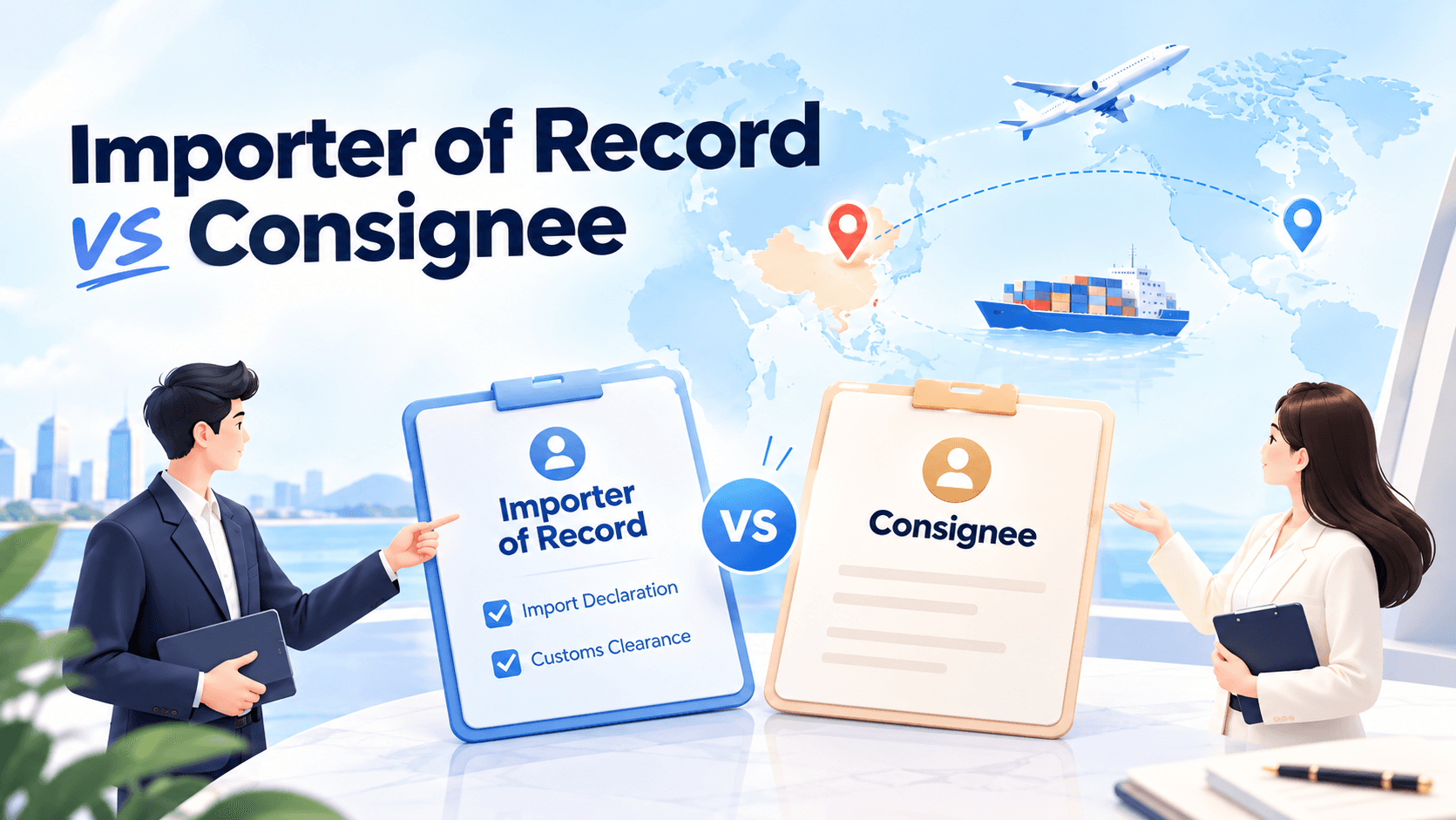
In international shipping, the Importer of Record and the consignee may be the same company, but they do not describe the same role.
The Importer of Record (IOR) is the party identified under the confirmed import arrangement as responsible for the customs declaration and related import obligations. The consignee is the party named to receive the shipment in the relevant transport or import documents.
The key distinction is simple: receiving goods does not, by itself, make a company responsible for the import. A delivery address, warehouse name, or entry in the consignee field is not enough to establish who the Importer of Record is.
Contents
- Importer of Record vs Consignee: The Core Difference
- What Is an Importer of Record?
- Must the Importer of Record Be the Buyer or Owner?
- What Is a Consignee?
- Consignee, Ship-to Party, and Notify Party
- When Are the IOR and Consignee the Same Party?
- When Are They Different Parties?
- How Does Your Agent Fit In?
- How the Roles Appear in Shipping Documents
- When Clearance Requires Transaction Evidence
- Why Preparing Documents Does Not Make a Party the IOR
- Example: The IOR and Consignee Are Different
- Signs That the Roles Are Not Yet Aligned
- Problems Caused by Mixing Up the Roles
- What to Confirm Before Shipping
- Who Handles Missing Documents and Exceptions?
- Frequently Asked Questions
- Summary
Importer of Record vs Consignee: The Core Difference
| Point of comparison | Importer of Record | Consignee |
|---|---|---|
| Core role | The responsible party under the confirmed import arrangement | The receiving party named in the relevant shipping or import documents |
| Main focus | Importer identity, declaration information, duties and taxes, and applicable import requirements | Receiving details, contacts, appointments, and delivery requirements |
| Import responsibility | Assumes the responsibilities attached to the confirmed import arrangement | Does not become the IOR merely by receiving the goods |
| Where the role appears | Import declarations, authorizations, and related import records | Bills of lading, air waybills, arrival notices, and delivery instructions |
| Physical receipt | May or may not receive the shipment | Usually receives the shipment or coordinates its receipt |
| Can one company hold both roles? | Yes | Yes, when the actual import arrangement supports it |
Importer terminology, eligibility, and documentation vary by destination. The parties should therefore be confirmed for the specific destination, goods, and clearance arrangement rather than copied automatically from a previous shipment.
What Is an Importer of Record?
The Importer of Record is the party confirmed as responsible under the import arrangement that applies at destination.
The exact obligations depend on the country, product, and declaration method. They may include:
- confirming the importer’s identity and registration details;
- confirming the product description, use, and materials;
- confirming the customs value and transaction information;
- confirming tariff classification and country-of-origin information;
- handling applicable import duties and taxes;
- providing the necessary import authorization;
- providing permits, certifications, or other regulatory records;
- responding to questions from customs or other authorities; and
- retaining import records where required.
The IOR may ask your agent to help organize information, arrange transportation, or coordinate with the party handling the customs declaration. Performing those tasks does not automatically transfer the IOR’s identity or responsibilities to your agent.
Likewise, where permitted, an authorized customs broker or representative may submit a declaration on behalf of the confirmed importer without becoming the IOR for that shipment.
Must the Importer of Record Be the Buyer or Owner?
Not necessarily. However, the IOR generally needs a valid basis and the required eligibility to take that role under the applicable law and import arrangement.
Buyer, owner, Importer of Record, and consignee describe different relationships:
- Buyer identifies the purchasing party in the commercial transaction.
- Owner identifies the party that holds title or another ownership interest in the goods.
- Importer of Record identifies the party responsible under the applicable import arrangement.
- Consignee identifies the receiving party in the relevant documents.
One company may hold several of these roles, or only one. A purchase contract, payment record, or delivery address alone does not determine who the IOR is.
If another party will act as the IOR, confirm before departure that it accepts the goods and the proposed import arrangement, and identify the information and authorization it must provide.
What Is a Consignee?
The consignee is the receiving party named in the relevant shipping or import documents.
Depending on the shipment, the consignee may be:
- the company purchasing the goods;
- the business that will use them;
- a distributor or reseller;
- a third-party or overseas warehouse;
- another designated receiving party; or
- an importing company that also acts as the IOR.
The consignee normally provides an accurate legal name, contact details, delivery address, and any applicable receiving instructions.
For warehouse deliveries, the required details may also include:
- the appointment procedure;
- an inbound reference number;
- item and carton labeling rules;
- pallet requirements;
- unloading restrictions; and
- available receiving dates and times.
A consignee should not be reduced to a delivery address. The named receiving party, final destination, and warehouse operator may be connected, but they are not necessarily the same field or legal entity.
Are the Consignee, Ship-to Party, and Notify Party the Same?
Not always.
- Consignee is the receiving party named in the relevant transport or import document.
- Ship-to party identifies the party or location to which the cargo is ultimately delivered.
- Notify party identifies the party to contact when the shipment arrives or its status changes.
All three may be the same company in a simple shipment. They may also be different when an importing company, distributor, and warehouse participate separately.
For example, an importing company may act as the IOR, an overseas warehouse may be the consignee or ship-to party, and another contact may be listed as the notify party.
Each field should follow the carrier document, clearance arrangement, and destination requirements. A shared address does not mean the parties share the same responsibilities.
When Are the IOR and Consignee the Same Party?
A company may act as both the Importer of Record and the consignee when it assumes the import role and receives the goods at destination.
For example, a company may buy inventory abroad, import it under its own details, and deliver it to its own facility. The same company may then appear in both the import records and the receiving documents.
This arrangement commonly means that the company:
- buys or owns the goods;
- uses its own importer information;
- confirms the declaration and related import matters; and
- receives the shipment itself or through its own facility.
Even when one company holds both roles, each document must still be completed for its intended purpose. A matching company name does not make the bill of lading, commercial invoice, import declaration, and warehouse delivery details interchangeable.
When Are the IOR and Consignee Different Parties?
The roles are separate when one company is responsible for the import arrangement and another receives the goods.
Common examples include:
- a company acting as the IOR handles the import while an independent overseas warehouse receives the inventory;
- a brand acts as the IOR while a third-party warehouse stores and fulfills the goods;
- goods are delivered to a distributor after import clearance;
- a business uses an established importing entity while another company manages the inventory; or
- the goods are delivered to a warehouse while the owner or buyer acts as the IOR.
Separate roles do not indicate a problem. The important point is to confirm before shipment:
- who takes the import role;
- who provides and confirms import information;
- which party appears in each shipping document;
- who receives the goods; and
- who decides how to respond when information or instructions are missing.
What Is the Difference Between the IOR, Consignee, and Your Agent?
All three may participate in one international shipment, but their work is not interchangeable.
| Party | Primary role | What should not be assumed |
|---|---|---|
| Importer of Record | Provides or validates the information required for the customs declaration and assumes the applicable import responsibilities | Does not necessarily receive or store the goods |
| Consignee | Receives the shipment or coordinates receipt under the confirmed arrangement | Does not become the IOR merely by receiving the goods |
| Your agent | Uses confirmed information to help prepare the cargo, organize documents, arrange transportation, and coordinate requirements | Does not become the IOR merely by performing logistics or document work |
Your agent may assist with:
- receiving and checking goods;
- recording quantities, weights, and dimensions;
- helping prepare the Commercial Invoice and Packing List;
- providing cargo data to the carrier, freight forwarder, or other transport provider;
- forwarding confirmed import information;
- tracking the shipment;
- coordinating delivery appointments; and
- directing requests for missing information to the party authorized to answer them.
These are logistics and information-coordination tasks. Unless the formal import arrangement expressly establishes otherwise, preparing documents, contacting carriers, or following up on clearance does not make your agent the Importer of Record.
Who Performs the Work, and Who Confirms the Information?
| Task | Importer of Record | Consignee | Your agent or the party handling the declaration |
|---|---|---|---|
| Confirm the importer | Responsible for or participates in confirmation | Does not assume the role by receiving the goods | May identify missing information |
| Confirm declaration information | Provides or validates the required information | Assists if relevant to its actual role | Organizes or submits confirmed information |
| Record final carton data | Usually does not measure warehouse cargo | Usually not responsible | May record data from the actual packed goods |
| Prepare shipping documents | Provides or confirms import information | Provides receiving information | May compile and prepare documents |
| Receive the shipment | Not always | Usually receives or coordinates receipt | May coordinate delivery |
| Follow up on document requests | Responds on import matters | Responds on receiving matters | Relays requests and follows the status |
The person who prepares or uploads a document is not necessarily the party responsible for the information it contains. Roles should be determined from the confirmed commercial, import, and transportation arrangements.
How Do These Roles Appear in Shipping Documents?
An international shipment can involve several commercial, transportation, and import records. Each document serves a different purpose and may identify different parties.
| Document or record | Main purpose | Information it may contain |
|---|---|---|
| Pro Forma Invoice | Sets out the proposed goods and transaction details before shipment | Products, quantities, values, and transaction parties |
| Commercial Invoice | Describes the commercial transaction and goods shipped | Seller, buyer, product description, quantity, value, and transaction terms |
| Packing List | Shows how the goods are packed | Carton count, weight, dimensions, and carton contents |
| Bill of Lading or Air Waybill | Records the transportation and cargo-routing arrangement | Shipper, consignee, notify party, and shipment data |
| Importer Information | Identifies the party responsible under the import arrangement | IOR name, address, identification details, and necessary authorization |
| Warehouse Requirements | Explains how the destination will receive the goods | Address, contacts, labels, appointments, and receiving restrictions |
| Compliance Documents | Support product- or market-specific requirements | Permits, certifications, or other regulatory records |
A company does not assume every legal role connected with a document merely because it prepared that document.
For example, your agent may compile a Packing List from the final packing results and prepare a Commercial Invoice from information confirmed by the relevant transaction parties. That does not automatically make your agent the seller, buyer, or Importer of Record.
Similarly, the appearance of a warehouse address in transportation records does not automatically make the warehouse responsible for the import.
The same role distinction applies regardless of transport mode. For smaller consolidated sea-freight shipments, this guide to LCL shipping from China for small businesses explains the separate planning considerations for cargo size, timing, and documentation.
When Clearance Requires Supporting Transaction Evidence
Customs or the party handling clearance may request proof of payment or other transaction evidence when reviewing the declared value or the information shown on the Commercial Invoice. Where applicable, the supporting documents should make clear how the total amount is made up, including the goods value, freight, insurance, and other relevant charges, so that it can be reconciled with the invoice. This follows the practical document-matching approach described in the DHL Express Global Customs Customer Guidelines.
Your agent may relay the request, check whether the available records are complete, and pass the documents supplied by the customer or relevant transaction party to the customs broker or other party handling clearance. The actual transaction parties remain responsible for providing and confirming the payment evidence and commercial information.
Helping organize or transmit transaction evidence does not make your agent the buyer, seller, consignee, or Importer of Record.
Why Does Preparing Shipping Documents Not Make a Party the Importer of Record?
Shipping documents combine information from several sources:
- quantities, weights, dimensions, and carton counts may come from packing records;
- product names, materials, and intended uses may come from product records;
- prices and buyer-seller information come from the commercial arrangement;
- IOR details come from the confirmed import arrangement;
- consignee details come from the confirmed receiving arrangement; and
- labels, appointments, and inbound rules come from the destination warehouse.
Your agent may organize this information into the required documents, but each category still needs to be provided or confirmed by the party authorized to do so.
It is therefore important to separate:
- the party that prepares, organizes, or submits a document; and
- the party responsible for confirming particular information and the import arrangement.
Those parties may be the same, but they do not have to be.
Example: The Importer of Record and Consignee Are Different
Consider an ecommerce company that buys inventory from several overseas suppliers. A company already confirmed as the IOR handles the import, while an independent overseas warehouse receives the shipment.
The work may be divided as follows:
- the ecommerce company confirms the products, transaction, and shipment arrangement;
- your agent receives the suppliers’ goods and records the final cargo data;
- your agent prepares shipping documents from the confirmed information;
- the company acting as the IOR provides its importer details and necessary authorization;
- the warehouse, acting as consignee or designated receiver, provides its address and receiving requirements; and
- your agent coordinates the shipping information, import information, and destination delivery requirements.
The IOR and the warehouse hold different roles. Delivery to the warehouse does not, by itself, make that warehouse the Importer of Record.
If final carton data is requested, your agent may verify it against the packed cargo. If import authorization or declaration information is required, the IOR or another authorized party must provide it.
This example only illustrates how the roles can be separated. The actual arrangement must be confirmed for the destination, goods, and shipment.
What Indicates That the Shipment Roles Are Not Yet Aligned?
The following signs call for another review before departure:
- the Commercial Invoice, bill of lading, and importer records use different company names without an explanation;
- only a warehouse address is available, with no complete consignee identity;
- the consignee is asked for importer information even though it agreed only to receive the goods;
- the IOR has been selected, but its authorization or identification details are missing;
- your agent is expected to decide the declared value, classification, or importer without confirmation;
- the notify party, consignee, and final delivery address have been copied as the same entity without verification; or
- the importer or final destination changes after booking.
These issues do not necessarily prevent shipment, but they show that the roles and records have not yet been fully aligned.
What Can Go Wrong When the IOR and Consignee Are Confused?
The shipment departs before the Importer of Record is confirmed
A delivery address alone does not ensure that an eligible party is ready to complete the import arrangement when the goods arrive.
A receiving warehouse is listed as the IOR without confirmation
A warehouse’s agreement to receive goods does not mean that it has agreed or is eligible to assume import responsibility.
The legal name does not match the authorization
Differences between the IOR’s name, identification details, and authorization may trigger a request for correction or additional records.
The same address is copied into every role field
The shipper, consignee, notify party, IOR, and final delivery address serve different purposes and should not be made identical without confirmation.
Commercial records do not match the actual cargo
Quantities, weights, and carton counts that cannot be reconciled across the Commercial Invoice, Packing List, and carrier records may require another review.
The parties change after booking
Changing the IOR, consignee, or final destination may affect transportation documents, clearance arrangements, and delivery.
What Should Be Confirmed Before Shipping?
You do not need to master every import rule before shipping, but the parties involved should be able to answer these questions:
- Who is the Importer of Record for this shipment?
- Who is the consignee?
- Are the IOR and consignee the same party?
- Who provides the importer details and necessary authorization?
- Who confirms the product description, value, and transaction information?
- Who prepares or organizes the shipping documents?
- Who handles the destination appointment and receipt?
- Whom should your agent contact if additional information is requested?
- Who approves extra costs or a change in the plan?
- Do the goods require additional permits, certifications, or special transport records?
If a critical role remains unclear, resolve it before the goods depart.
Who Handles Missing Documents and Shipment Exceptions?
When information, inspection support, or delivery instructions are missing, first identify which type of information is required.
- The warehouse or your agent may verify physical quantities, weights, dimensions, and packing details.
- The buyer, seller, or relevant customer confirms product and transaction information.
- The IOR or another authorized party provides importer details, import authorization, and declaration information.
- The consignee or receiving party confirms the address, appointment, and receiving restrictions.
- Your agent may relay the request, organize the available records, and follow the status.
This division is not about passing a problem to someone else. It ensures that each statement is supplied or confirmed by a party with the information and authority to do so.
Frequently Asked Questions
Can the consignee also be the Importer of Record?
Yes, if the party is confirmed under the actual import arrangement and can provide the required importer information and authorization. Its appearance in the consignee field or physical receipt of the goods is not enough on its own.
Must the Importer of Record be the final receiver?
No. The IOR may handle the import arrangement while another company, warehouse, or designated location receives the shipment.
Can an overseas warehouse act as the Importer of Record?
Do not assume so merely because the warehouse receives the goods. Confirm whether it agrees and is eligible to take the import role for that shipment. Receiving services and import responsibility should be confirmed separately.
If your agent prepares the Commercial Invoice and Packing List, does that make the agent the IOR?
No. Your agent may organize documents using actual cargo data and information confirmed by the relevant parties. Importer details, declaration decisions, and necessary authorization still come from the IOR or another authorized party.
Is a customs broker the same as the Importer of Record?
Not necessarily. A customs broker may perform declaration work for a confirmed importer without assuming the IOR role.
Does the consignee matter only after customs clearance?
No. Consignee information may be required during booking and document preparation, and it can affect arrival notices, delivery appointments, and final receipt.
Summary
The Importer of Record and consignee describe two different roles:
- the Importer of Record is responsible under the applicable import arrangement and for the related import information;
- the consignee is the receiving party identified in the relevant shipping or import documents;
- one company may hold both roles, or the roles may be divided between different parties; and
- your agent may prepare cargo, organize documents, arrange transportation, and coordinate information without automatically becoming the Importer of Record.
Confirming the IOR, consignee, and your agent’s operational scope before departure helps reduce document conflicts, missing authorization, and incomplete destination receiving arrangements.