
EU €3 Customs Duty + €2 Union Handling Fee: How Sellers Can Protect Margins
 Written by Olivia ZhangPublished
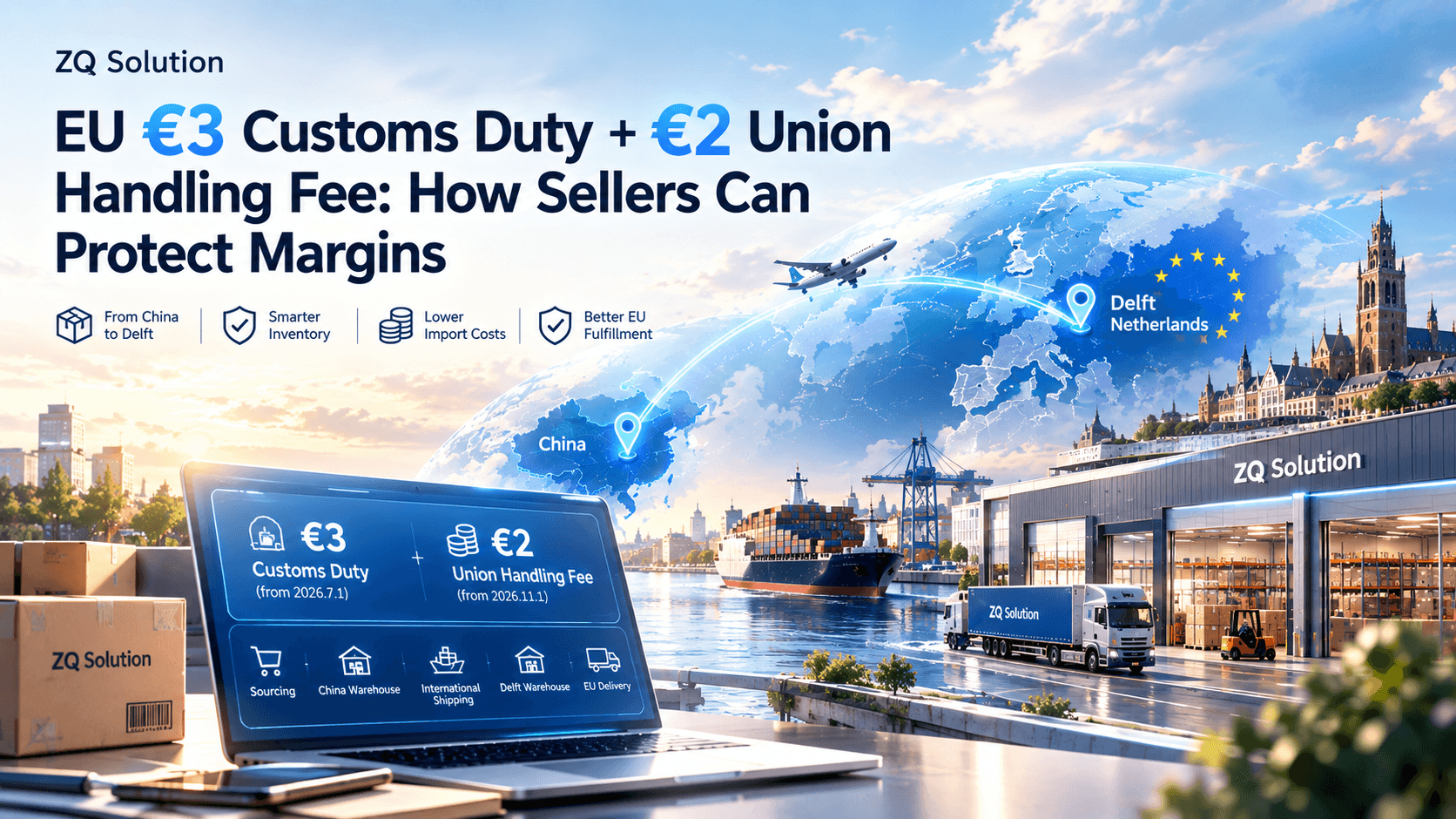
As of October 2026, low-value ecommerce goods sent to EU consumers no longer follow the old duty-free cost model. The change applies when the goods enter from outside the EU.
The EU introduced a temporary €3 customs duty on eligible ecommerce imports worth no more than €150 on July 1, 2026. From November 1, 2026, the Union Handling Fee adds €2 for each distinct item in an ecommerce shipment. Irish Revenue states that the fee covers shipments arriving from outside the EU.
For an order covered by both measures, the added import cost may be:
€3 Customs Duty + €2 Union Handling Fee = €5 per distinct item
The €5 is not a flat charge for the whole parcel. A parcel with several distinct product categories can incur the charges more than once. Sellers shipping each order from a non-EU country must add these charges to the landed cost. The charges can also affect checkout pricing and delivery experience.
ZQ Solution does not present these charges as costs that a warehouse can simply remove. The alternative is to change how suitable stock enters the EU and where consumer orders begin.
ZQ can prepare and consolidate inventory in China. It can then connect the bulk shipment to Delft and fulfill later orders from within the EU.
Table of Contents
- What changed with the €3 customs duty and €2 Union Handling Fee?
- How are the €3 duty and €2 fee calculated, and who pays them?
- Does IOSS cover the new import charges?
- Why do the new charges affect direct-to-consumer shipping margins?
- How can a Netherlands warehouse reduce repeat import events?
- How does ZQ connect China sourcing with Delft fulfillment?
- How is ZQ different from a Europe-only 3PL?
- Which products should move to the Netherlands?
- Who remains responsible for imports, VAT, and compliance?
- Frequently asked questions about the EU charges and ZQ fulfillment
What changed with the €3 customs duty and €2 Union Handling Fee?
The EU introduced 2 separate charges. They should not be described as one fixed €5 parcel fee.
The temporary €3 customs duty took effect on July 1, 2026. It applies to eligible ecommerce goods worth no more than €150 when they enter from a non-EU country.
The European Commission bases the charge on the tariff classification of the goods. It is not a simple count of physical units in the parcel.
For example, 5 T-shirts under the same tariff classification would normally create one €3 charge. A parcel containing T-shirts and watches may create 2 charges because it contains 2 tariff categories.
Irish Revenue's Union Handling Fee guidance states that a further €2 fee applies from November 1, 2026. It covers each distinct item in ecommerce goods sent directly to consumers from outside the EU. Unlike the temporary €3 duty, the handling fee has no €150 value threshold.
| Charge | Start date | Main scope | Calculation basis |
|---|---|---|---|
| €3 Customs Duty | July 1, 2026 | Eligible ecommerce imports worth no more than €150 | Each tariff classification or declared product category |
| €2 Union Handling Fee | November 1, 2026 | B2C ecommerce goods entering from outside the EU, with no value threshold | Each distinct item |
| VAT | Already applies | Depends on the sales and import setup | Taxable value, which may include goods, shipping, and duty |
The €3 plus €2 formula shows a possible cost combination. It does not mean that every parcel will face one fixed €5 charge.
How are the €3 duty and €2 fee calculated, and who pays them?
The party that pays the charge first depends on the sales, platform, carrier, and import setup. The commercial result is the same: the cost enters the order economics somewhere.
The European Commission states that the seller or importer declares and pays the €3 duty through the customs process. The Union Handling Fee applies to platforms, marketplaces, and other businesses that bring ecommerce parcels into the EU. It is not designed as a fee charged only to consumers.
In practice, the cost may be handled in 3 ways:
- The seller or marketplace includes it in the product price.
- The checkout shows it as a separate charge.
- The carrier collects it before delivery.
Charges collected at delivery can be difficult for customers to understand. A customer may see customs duty, the handling fee, VAT, and a carrier clearance charge as one unexpected shipping bill. That can increase refused deliveries, support disputes, and returns.
Sellers therefore need to measure the added landed cost for each order. They also need to decide whether the selling price can absorb it without damaging conversion.
Does IOSS cover the new import charges?
No. IOSS deals with VAT on eligible imported distance sales worth no more than €150. It does not remove the €3 customs duty or the €2 Union Handling Fee.
The European Commission's €3 Customs Duty VAT Guidelines treats customs duty and VAT as separate obligations. An order may use IOSS to collect VAT at checkout and still face the applicable duty and handling fee.
IOSS still serves a useful purpose. It can reduce the risk of customers being asked to pay VAT again at delivery. It is not an exemption from the new import costs.
For each EU order, sellers should confirm:
- how sales VAT is collected;
- how the €3 duty is declared;
- who pays the Union Handling Fee;
- whether the carrier adds a clearance or processing charge; and
- whether the full cost is already included at checkout.
ZQ's guide to the EU €3 duty, IOSS, and Netherlands warehouse fulfillment explains how the charges differ across import models.
Why do the new charges affect direct-to-consumer shipping margins?
Direct shipping from outside the EU remains a valid fulfillment model. The pressure comes from repeating the import process for every consumer order.
Before July 2026, ecommerce parcels worth no more than €150 could enter under the customs duty exemption. An eligible low-value order may now face the €3 duty, the €2 handling fee, VAT, and carrier processing charges.
The impact is usually greater when:
- the selling price is low and the new charge takes a large share of revenue;
- one parcel contains several distinct product categories;
- the store receives steady EU orders and repeats the import process each month;
- return rates are high, so the import cost is harder to recover; or
- the seller promises a checkout price with no extra payment at delivery.
Consider a parcel containing a pen, a notebook, and a key ring. The official Irish Revenue example shows that the €3 duty and €2 fee may total €15 for 3 distinct items. VAT may also apply.
Combining several products into one consumer parcel does not always limit the cost to one €5 charge. The product mix can change the import cost.
How can a Netherlands warehouse reduce repeat import events?
A Netherlands warehouse does not remove customs duty, import VAT, or clearance responsibilities. It changes when stock is imported and whether each later consumer order must cross the EU external border.
With direct-to-consumer shipping from a non-EU country, every order enters the EU separately. Customs duty, the handling fee, VAT, and carrier charges may arise around each import parcel.
With Netherlands fulfillment, stock first enters the EU as a commercial bulk shipment. Customs treatment depends on the product classification, origin, declared value, transport route, and importer.
After customs release, the inventory enters free circulation and is stored in the EU. Later parcels sent from the Netherlands do not create the same low-value import event again.
Dutch Customs has already reported a change in shipping patterns. From July to August 2026, low-value ecommerce declarations fell by 46% from the first-half monthly average. Declaration lines fell by 70%, while standard import declarations increased. Dutch Customs linked the change to more businesses choosing to import in bulk and store inventory inside the EU.
This is not a way to avoid tax. It is a move from parcel-by-parcel ecommerce imports to commercial bulk imports followed by local EU fulfillment.
How does ZQ connect China sourcing with Delft fulfillment?
ZQ Solution can connect China-based supply chain work with fulfillment from Delft. This gives the seller one operating path from supplier coordination to EU order dispatch.
In China, ZQ can buy products under an approved purchasing plan. It can also receive stock that the seller has ordered from several suppliers.
Within the agreed service scope, the ZQ China warehouse can handle:
- receiving and checking SKU quantities;
- the selected level of quality inspection;
- labels, barcodes, and packaging;
- kitting, inserts, and repacking;
- consolidation across suppliers and SKUs; and
- export packing and shipment document preparation.
Prepared stock can then move to Delft through an agreed sea, air, or rail option. The relevant logistics partners handle international transport, import clearance, and tax processing under the seller's confirmed import setup.
After arrival, the ZQ Delft warehouse can receive and store inventory. The team can record stock, process orders, pick and pack, hand parcels to carriers, and handle approved returns. See ZQ's European warehousing and 3PL services for the current service scope.
The value is not a European delivery address on its own. ZQ reduces the operational gaps between China sourcing, stock preparation, international transport, EU warehousing, and order fulfillment.
How is ZQ different from a Europe-only 3PL?
Many European 3PL providers begin work after the goods reach their warehouse. ZQ can begin at the China sourcing and inventory preparation stage, then continue the process in Delft.
| Supply chain stage | Europe-only 3PL | ZQ China-to-Delft setup |
|---|---|---|
| China purchasing | Seller arranges it separately | ZQ can purchase under the approved plan |
| Supplier coordination | Seller or another sourcing agent handles it | ZQ can coordinate several China suppliers |
| Domestic receiving in China | Requires a separate setup | ZQ's China warehouse can receive the stock |
| Inspection and labels | Separate provider or work in Europe | ZQ can complete approved work before export |
| Multi-supplier consolidation | Arranged separately | ZQ can consolidate stock in China |
| Export preparation | Split across the seller, warehouse, and forwarder | ZQ prepares stock and shipment information |
| EU storage and fulfillment | 3PL handles it | ZQ's Delft warehouse continues the process |
| EU returns | Depends on the provider | Delft can follow the seller's approved return rules |
This continuity matters when a seller has many SKUs, several suppliers, or more than one sales channel. Product, label, packing, and inventory requirements do not need to be handed between unrelated providers at every stage.
Which products should move to the Netherlands?
Netherlands fulfillment is best suited to SKUs with stable EU demand and predictable turnover. Repeated import costs must also create enough margin pressure to justify local stock.
Sellers do not need to choose one route for their full catalog. A product-level inventory plan usually works better.
| SKU status | Better starting route | Main reason |
|---|---|---|
| New or unproven product | Direct shipping from outside the EU | Limits inventory exposure and slow-stock risk |
| Long-tail or low-frequency SKU | Direct shipping from outside the EU | Avoids storage costs on slow stock |
| SKU with repeat EU orders | Small batch in Delft | Balances import cost and inventory risk |
| Stable, high-volume SKU | Planned replenishment to Delft | Supports ongoing local fulfillment |
| Product with recoverable return value | Local handling in Delft | Allows inspection, repacking, and possible resale |
The €3 plus €2 charge is only one part of the decision. Sellers should compare bulk transport, commercial import costs, receiving, storage, order handling, EU delivery, returns, and the cash tied up in inventory.
ZQ's Netherlands 3PL and direct shipping cost comparison breaks down the 2 fulfillment models in more detail.
Who remains responsible for imports, VAT, and compliance?
Using the ZQ Delft warehouse does not automatically transfer the Importer of Record role or VAT obligations. Product compliance and marketplace duties also remain subject to the seller's setup.
ZQ performs the agreed sourcing, supplier communication, warehouse work, quality inspection, labeling, packing, inventory preparation, Delft storage, order fulfillment, and return handling.
Logistics partners handle international transport, import clearance, and related tax processing under the selected route and import setup. The seller still needs to confirm the Importer of Record, import VAT, and sales VAT. The seller must also confirm product safety, labeling, EPR, PPWR, and marketplace requirements.
Receiving and storing the inventory does not make ZQ the seller's Importer of Record or customs broker by default.
For a clearer division of roles, read ZQ's guide to the Importer of Record and consignee.
Frequently asked questions about the EU charges and ZQ fulfillment
Does the €2 Union Handling Fee apply to orders worth more than €150?
Yes. Under the current Irish Revenue guidance, the €2 handling fee has no order value threshold. Goods worth more than €150 do not use the temporary fixed €3 duty. Normal tariff rates may apply instead, while the handling fee can still be charged for each distinct item.
Are the €3 duty and €2 handling fee refunded after a return?
The Union Handling Fee is not refunded when goods are faulty or returned. A refund of customs duty or VAT may depend on the import declaration, parcel value, and customs process in the member state. Sellers should confirm the procedure with the carrier and the customs authority for the country of import.
Can ZQ consolidate inventory from several China suppliers?
Yes. ZQ's China warehouse can receive goods from several suppliers and check the approved SKUs and quantities. It can complete agreed labeling and packing work, then consolidate the stock before transport to Delft.
Can the ZQ Delft warehouse handle Amazon, TikTok Shop, and TEMU inventory?
ZQ Delft can support suitable Amazon FBA preparation, TikTok Shop orders, and TEMU semi-managed orders. The process depends on the seller's market, operating model, platform labels, account permissions, and carrier setup. See the ZQ Delft platform fulfillment guide for details.
Can ZQ process consumer returns in Europe?
Yes. The Delft warehouse can receive EU returns and follow the seller's approved rules. Available work includes inspection, restocking, relabeling, repacking, forwarding, and temporary storage. The next step depends on the product condition and the seller's written instructions.
Will ZQ Solution become the seller's Importer of Record?
No. Providing warehousing or fulfillment does not make ZQ the Importer of Record by default. The importer, clearance method, and tax responsibilities must be confirmed for the seller's company structure, transport route, and logistics plan.
What information does ZQ need to quote Netherlands fulfillment?
ZQ normally needs the SKU types, inbound quantity, carton data, expected stock level, and monthly order volume. The quote also requires the main destinations, average units per order, sales channels, and any label, packing, or return work. ZQ uses these details to separate China services, bulk transport, Delft operations, and EU delivery costs.
Move from repeat imports to a controlled EU fulfillment structure
The €3 customs duty and €2 Union Handling Fee do not mean every seller must stop shipping directly from outside the EU. They also do not make a Netherlands warehouse cheaper in every case.
The decision should happen at SKU level. New and long-tail products can keep the flexibility of direct shipping. Products with stable EU sales, faster turnover, and high repeat import costs may be better candidates for small-batch stock in Delft.
ZQ Solution can place the main work in one service chain. This includes China sourcing, consolidation, inspection, labeling, packing, bulk transport coordination, Delft storage, EU fulfillment, and returns.
Contact ZQ Solution to compare a China-to-Delft fulfillment plan against the current EU order mix and inventory turnover.